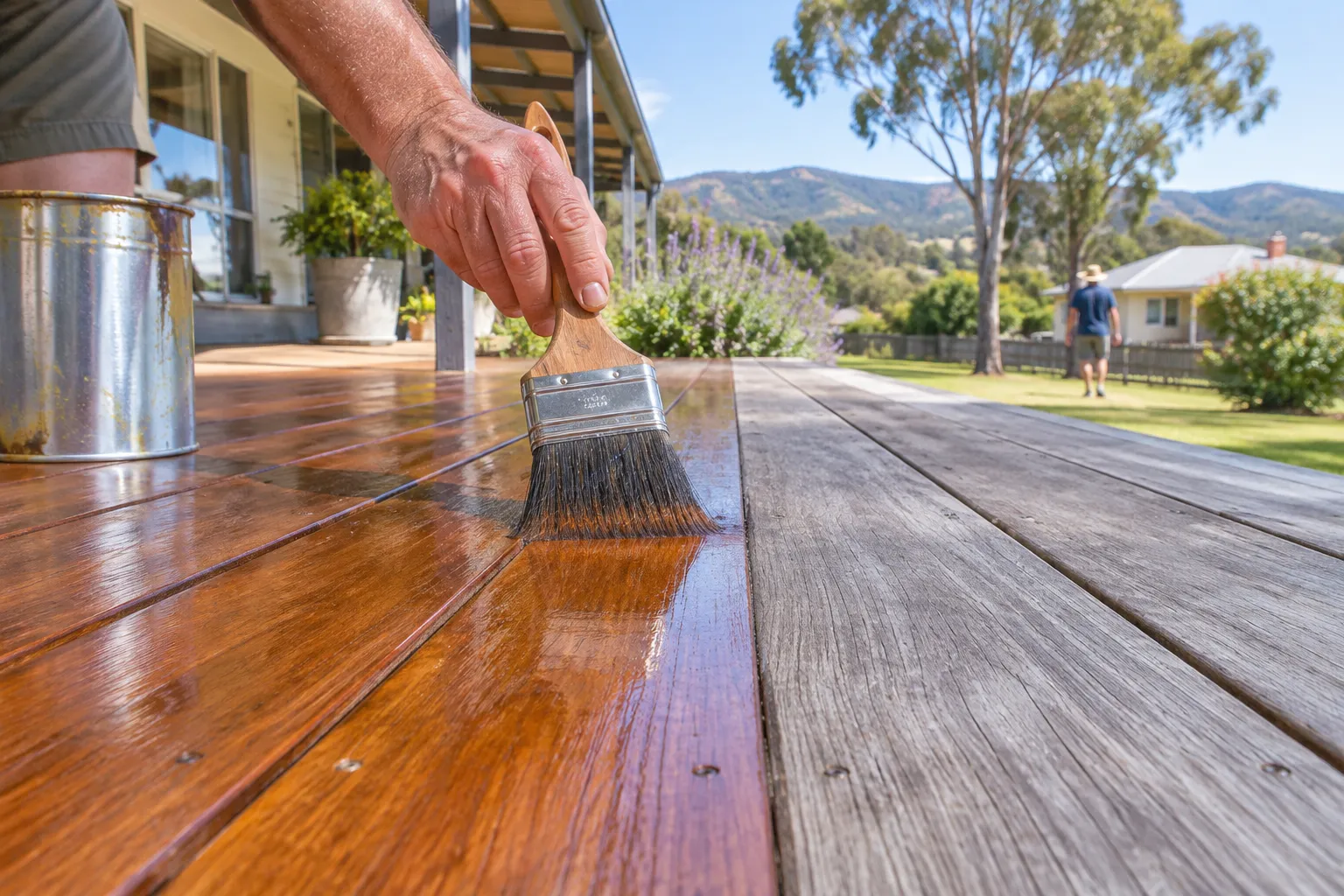
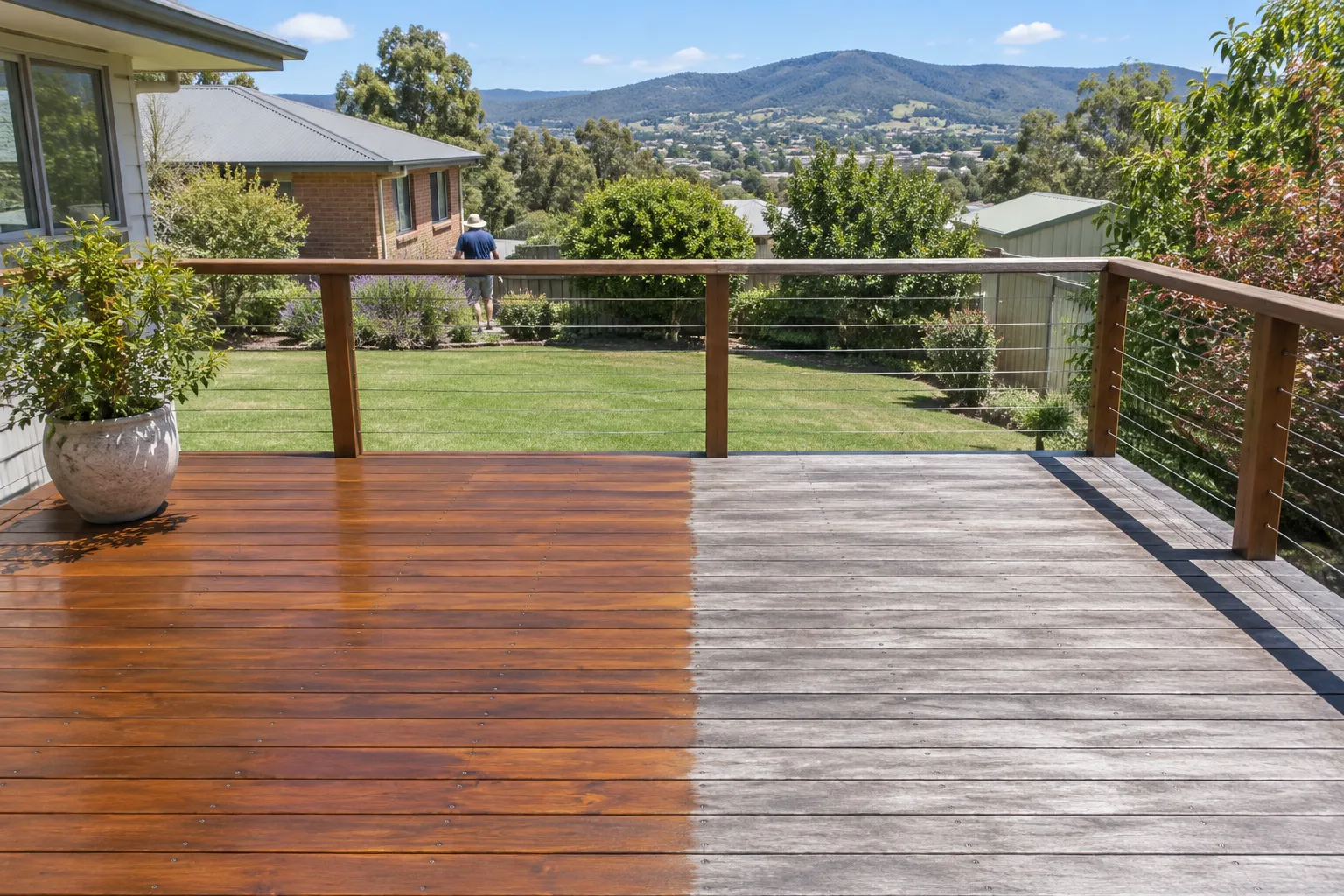
Deck oiling is cleaning a timber deck and brushing on a penetrating oil that soaks into the wood, slows water getting in and cuts down the sun damage that turns boards grey. Around Albury, most timber decks need it every 12 to 24 months, more often on a west-facing deck in full sun. Published Australian prices put a clean and re-oil at about $15 to $35 a square metre, and a full sand and two coats at about $35 to $70. This page covers how it's done, when not to do it, what rain does, and when to oil a new merbau deck. If you'd rather not do it yourself, we'll arrange a visit and a local deck specialist comes to you with a written quote.
How is a deck oiled or stained?
A deck is oiled in four steps: clean the boards, let them dry fully, apply thin coats of oil or stain with a brush or applicator along the grain, and let each coat dry before the next. Most decks get two coats. Wipe off anything that doesn't soak in within about 15 minutes, or it stays sticky.
In more detail:
- Clear and sweep. Move furniture and pot plants, sweep, and clear the gaps between boards.
- Clean. Use a deck cleaner and a stiff brush, then rinse. Grey, weathered boards may need a timber reviver. Our guide on how to clean a deck before oiling covers products and steps.
- Sand if needed. Old film-forming stain, deep grey or rough boards usually need sanding back to bare timber.
- Dry. The boards must be dry right through, usually two or three days of fine weather.
- Apply. Work two or three boards at a time, end to end, so you never leave a hard line across the deck.
- Second coat. Cabot's lists a 6 hour recoat time at 25 degrees and 50% humidity. Cooler or damp days take longer.
For the full DIY method, read how to oil a deck. If the finish turns tacky afterwards, why a deck is sticky after oiling explains the usual causes.
Should you oil or stain your deck?
Oil soaks into the timber and keeps its natural look. Stain adds colour, and some stains form a film on top. Penetrating oils are easier to re-coat because you don't need to strip them. Film stains last longer between coats but peel when they fail and usually need sanding off. For most Albury hardwood decks, a penetrating oil is the simpler choice.
| Finish | Look | How often | Re-coating |
|---|---|---|---|
| Penetrating oil | Natural, enhances grain | 12 to 24 months | Clean and re-oil |
| Tinted oil or semi-transparent stain | Adds colour, shows grain | 12 to 24 months | Clean and re-coat |
| Film-forming stain or deck paint | Solid colour | Longer, until it peels | Sand or strip first |
Our deck oil vs stain guide goes further, and stain deck colours shows popular shades. For painted decks, see painting decking timber.
When should you not oil or stain a deck?
Don't oil a deck when the boards are damp, when rain is forecast within a day, in full midday sun on a hot day, or when it's very cold. Wet timber can't absorb oil. Hot boards make oil dry on the surface before it soaks in, which leaves lap marks. Cold, humid weather slows drying.
Around Albury the best windows are usually mild, dry spells in autumn and spring. In summer, oil early in the morning or late afternoon, when the boards are shaded. Avoid days after a frost, when timber can still hold moisture.
What happens if it rains on a newly oiled deck?
Rain on fresh oil can leave water spots, a patchy or cloudy finish, or wash some oil off the surface before it's soaked in. Light rain after the oil is touch dry usually does little harm. Heavy rain within the first few hours often means you need to let it dry and re-coat the patchy boards. Some water-based oils say they handle light rain on the day.
If rain does catch you:
- Let the deck dry completely. Don't wipe at wet oil.
- Check for white marks or bare patches once it's dry.
- Lightly clean and re-coat only the boards that look uneven.
Checking the forecast for two dry days is the easiest way to avoid it.
Can you oil damp decking?
No, not with a standard oil. Damp timber is already full of water, so the oil can't soak in. It sits on top, stays tacky and wears off quickly. After washing or rain, most decks need two or three dry days before oiling. A simple test: sprinkle water on a board. If it beads, it's sealed. If it soaks in quickly and the board is dry, it's ready.
Some water-based products are more forgiving of slightly damp timber, but the label is the rule. If you're unsure, wait another day.
When should you oil a new merbau deck for the first time?
Most people wait about 6 to 12 weeks before oiling a new merbau deck. Merbau is full of tannin, a natural red-brown dye that bleeds out when the timber gets wet. Oiling too early traps it and gives a blotchy finish. Rinsing the deck often, or using a tannin remover, speeds this up. Check the board supplier's advice, since some pre-oiled boards differ.
Signs a new merbau deck is ready:
- Rain or hose water runs off clear, not brown.
- The colour has settled to an even tone.
- Water soaks into the surface rather than beading.
Merbau's tannin also stains concrete, render and pavers below the deck, so rinse the run-off away early. For product choice, see the best decking oil for merbau and our guide to oiling a merbau deck. Merbau is also sold as kwila in some places: it's the same timber. Oily imported hardwoods like ipe usually need a product made for dense timber.
What does deck oiling cost in Albury?
Published Australian price guides put a clean and re-oil on a deck that's been looked after at about $15 to $35 a square metre. A deck that needs stripping or sanding back and two fresh coats usually costs about $35 to $70 a square metre. So a 30 square metre deck often lands around $450 to $900 for a re-oil, or more with sanding.
What moves the price:
- Condition. Grey, rough or peeling decks need sanding or stripping first.
- Old finishes. Removing a failed film stain costs more than re-oiling over oil.
- Size and access. Steps, balustrades, screens and tight spaces take longer.
- The product. Premium oils cost more per litre.
These are guide figures. The specialist who visits gives you the real price in writing. Our pages on deck restoration cost and timber decking restoration cover bigger jobs, like replacing boards and fixings.
Questions people ask
How do you prepare decking before oiling?
Sweep the deck, clear the gaps, then scrub it with a deck cleaner and rinse well. Grey boards may need a timber reviver, and old peeling stain needs sanding off. Then let it dry for two or three fine days. The cleaner and drier the timber, the better the oil soaks in and the longer it lasts.
How long will decking oil last?
On a deck in Albury's sun, a penetrating oil usually lasts about 12 to 24 months before the boards start to look dry or grey. Shaded decks and covered decks under a pergola last longer. Heavy foot traffic and west-facing boards wear faster. When water stops beading on the surface, it's time for another coat. See how long decking oil lasts.
How long does a freshly oiled deck take to dry?
Most decking oils are touch dry in a few hours and ready for a second coat in about 6 hours at 25 degrees and moderate humidity, according to manufacturer data sheets. Cooler, humid days take longer. Leave it a day before light foot traffic and two or three days before putting furniture back, so the finish can harden.
How long should you wait to oil a new deck?
For most new hardwood decks, wait about 6 to 12 weeks so the surface weathers and tannins wash out. Treated pine can usually be coated sooner once it's dry, often after a few weeks. Pre-oiled boards follow the maker's advice. Our guide to treated pine decking stain covers pine in detail.
What is the best way to maintain a merbau deck?
Sweep it often, wash it a couple of times a year, rinse off any tannin run-off, and re-oil once water stops beading on the surface. That's usually every 12 to 24 months in Albury. Fix loose screws and lifted boards early. A light clean and re-oil each year is far cheaper than a full sand back later.
How do you clean a timber deck without damaging it?
Use a deck cleaner made for timber, a stiff broom and a garden hose. A pressure washer can rough up and splinter softer boards if it's used too close or too hard. Rinse well and let the deck dry before oiling. Our guide to cleaning timber decking covers mould, stains and grey boards.
In this section
- Best oil for merbau
How to choose a decking oil for merbau and spotted gum: oil-based vs water-based, tinted vs natural, oil vs stain, coverage and drying…
- Cabot's deck stain colours
Cabot's deck stain and decking oil colours: how the tinted range works, choosing a shade for merbau, spotted gum or pine, greys, testing…
- Cleaning timber decking
How to clean timber decking between oilings: routine sweeping and washing, leaf and tannin stains, mould, rust marks, bird droppings, and…
- Deck oil vs stain
Deck oil vs stain compared for Albury decks: penetrating oils, semi-transparent and solid stains, how each wears, recoating, look, cost…
- Deck restoration cost
What deck restoration costs in Albury and Wodonga.
- Deck sanding and staining
What a professional deck sanding and staining job involves in Albury and Wodonga: the process, equipment, timeframes, prices per square…
- Decking timber oil
Decking timber oils explained: natural and synthetic oils, linseed and tung, oil-based vs water-based, UV and mould protection, and how to…
- How long deck oil lasts
How long decking oil lasts on a timber deck in Albury: typical recoat times, what wears oil faster, the water test, and how to make a coat…
- Cleaning before oiling
How to clean a timber deck before oiling: deck cleaners vs timber revivers, removing grey and mould, pressure washing safely, sanding and…
- How to oil a deck
How to oil a timber deck step by step: cleaning, drying, sanding, applying coats and drying times, plus how often to re-oil a deck in…
- Oiling merbau deck
How to oil a merbau deck: when to oil new merbau, pre-oiled boards, choosing a merbau-tinted oil, how often to re-oil in Albury, and…
- Painting deck cost
What it costs to paint or stain a deck in Albury: professional prices per square metre, preparation and stripping costs, DIY materials,…
- Painting decking timber
Should you paint decking timber? Paint vs oil vs stain on decks, which timbers take paint, preparation, peeling, and what to do with a…
- Stain deck colours
How to choose a deck stain or tinted oil colour: what each timber can take, natural, merbau, grey and dark tones, heat in the sun, and…
- Stain merbau decking
How to stain merbau decking: tinted oils vs stains, which colours work on dark merbau, preparing for stain, application tips, and how long…
- Staining timber decking
How to stain timber decking: choosing a stain type, preparing the boards, applying thin even coats, drying, recoating and avoiding peeling…
- Timber decking restoration
How a timber deck is restored: checking the frame, replacing boards and fixings, sanding, refinishing, and when restoration is worth it…
- Treated pine decking stain
How to stain treated pine decking: how long to wait after building, choosing a stain or tinted oil, hiding the green tinge, preparation,…
- Sticky deck after oiling
Why a deck stays sticky after oiling: too much oil, cool or humid weather, damp timber, oiling new hardwood too soon, and how to fix tacky…
Every service and price guide is on deck builder in Albury.
Where these facts come from
- Cabot's Natural Decking Oil, product data sheet (recoat times at 25C and 50% humidity)
- Intergrain UltraDeck Timber Oil, product data sheet
- Published deck oiling and restoration prices from four Australian cost guides, checked November 2026
Updated