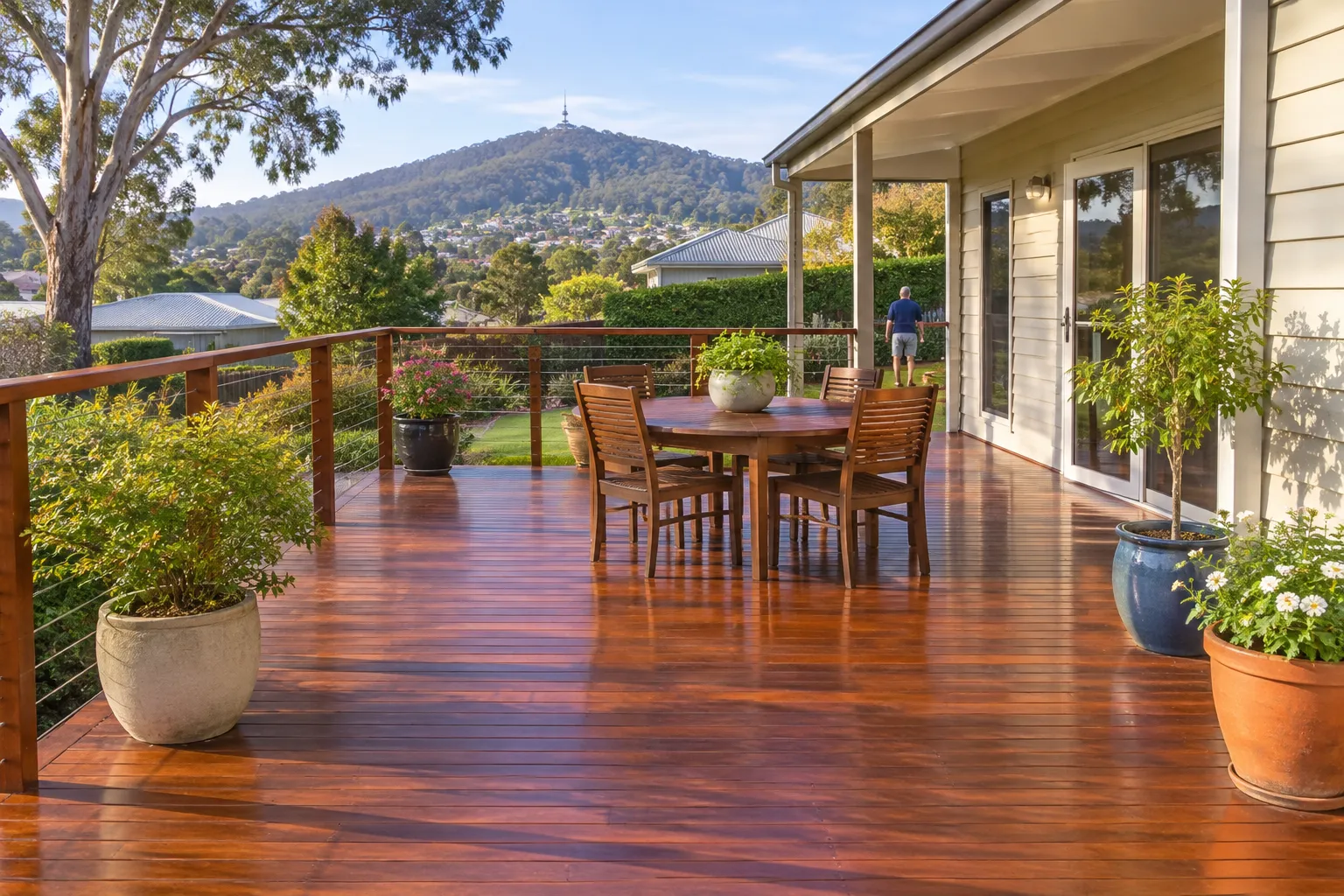
Looking for a deck builder in Albury or Wodonga? We arrange decks, pergolas, patios, verandahs and carports for homes on both sides of the Border, and the towns around them. Tell us what you want, we'll arrange a visit, and a local deck builder comes to you, looks at the site and gives you a written quote before any work starts. As a guide, an installed deck around Albury and Wodonga usually costs about $180 to $350 a square metre in treated pine, $300 to $600 in hardwoods like merbau and spotted gum, and $280 to $700 in composite. This page explains the options, what moves the price, the approval rules on each side of the Murray, and how the Border's climate shapes a good deck.
What does a deck builder in Albury and Wodonga do?
A deck builder designs and builds the raised floor outside your back door, and often the roof over it. That means checking the ground and levels, setting footings, building the frame of bearers and joists, laying the boards, and adding steps, balustrades and trims. Many also build the pergola, patio or verandah that goes with it, so the outdoor area works as one space.
What a typical job covers:
- Planning. Measuring the site, checking heights at the back door, slope, drainage and access.
- Approval. Working out whether the deck is exempt in NSW or needs a building permit in Victoria.
- Footings and frame. Concrete footings, then a treated pine or steel deck framing system.
- Boards. Timber or composite, fixed with screws or hidden clips.
- Finishing. Steps, a timber decking balustrade where needed, fascias and oil.
Every deck we arrange is quoted in writing first, so you know the price, the materials and the timeframe before anything starts.
How does getting a quote work?
Getting a quote takes three steps. You tell us what you have in mind using the quote form or a call. We arrange a visit at a time that suits you, and a local deck builder comes to your home to measure up and talk through options. Then you get a written quote that names the materials, the price and the timeframe, and you decide.
What helps the builder quote accurately:
- A rough size. Even a guess, like "about 5 by 4 metres", is a good start.
- Photos. Of the area, the back door and any existing deck.
- Your preferences. Timber or composite, a roof or not, a budget range.
- Anything you know about the block. A slope, a pool, a heritage listing, or bushfire mapping.
There's nothing to pay for the quote, and you're under no pressure to go ahead. For what to have ready before you contact us, see talk to us.
What are the different types of decking?
The main types of decking are natural timber, composite boards, and a few less common options such as fibre cement, aluminium and PVC. Timber is the classic choice and the cheapest in treated pine. Composite costs more upfront but doesn't need oiling. Fibre cement and aluminium suit special cases, like bushfire zones or wet areas.
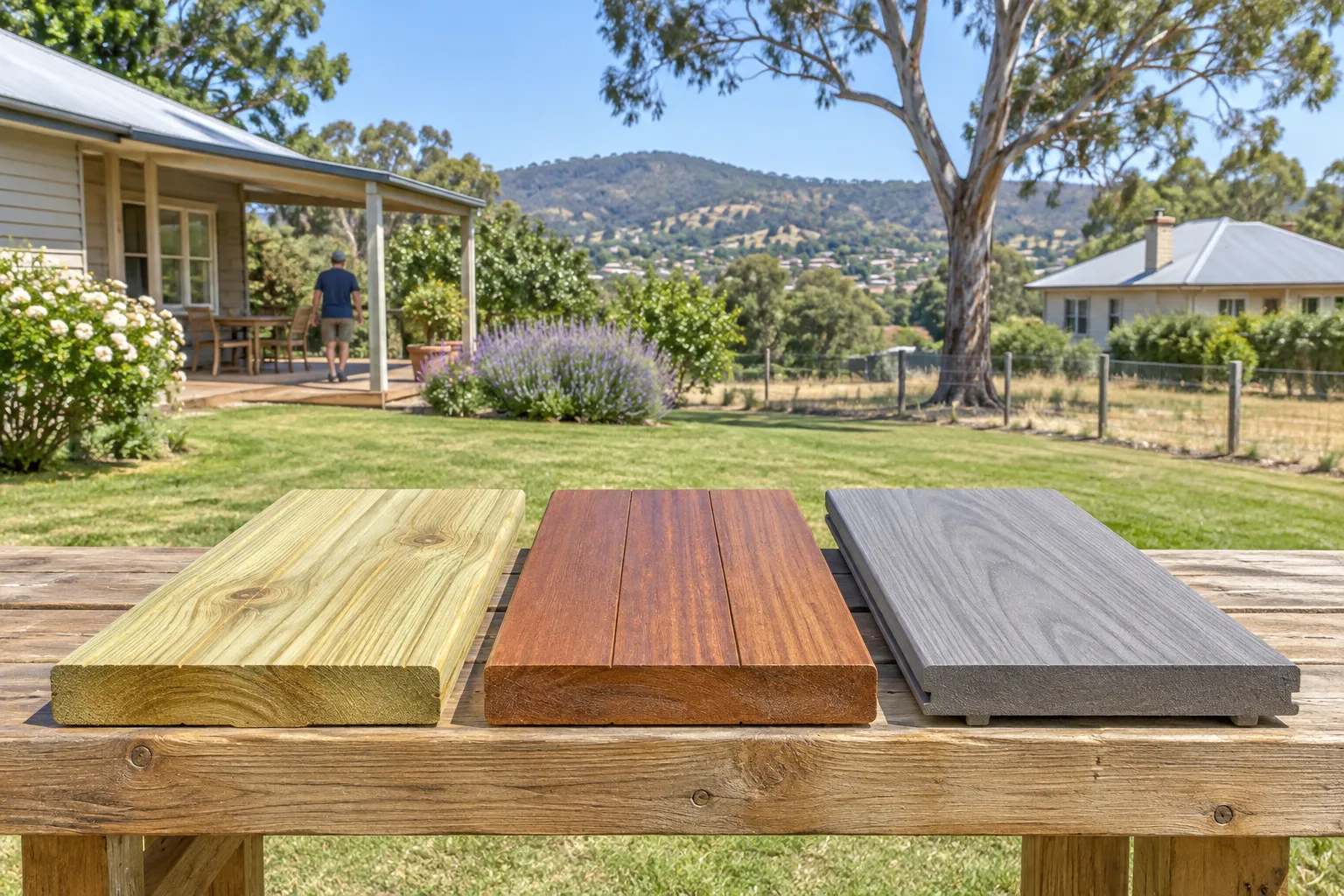
| Decking type | Typical installed cost per m2 | Upkeep | Good for |
|---|---|---|---|
| Treated pine | About $180 to $350 | Oil often | Budget decks, frames |
| Merbau | About $300 to $550 | Oil every 1 to 2 years | Rich even colour |
| Spotted gum | About $350 to $600 | Oil every 1 to 2 years | Hard-wearing, bushfire areas |
| Composite | About $280 to $700 | Wash only | Low upkeep, pools |
| Fibre cement, aluminium | Varies by product | Low | Bushfire zones, special cases |
"Fake timber decking" usually means composite, which is moulded to look like timber. For the boards and brands, see composite decking. Fibre cement deck boards such as HardieDeck cost more than treated pine, and are often compared with composite on price. They don't burn and won't rot, which suits some bushfire-prone blocks.
Which timber is best for a deck on the Border?
For most decks in Albury and Wodonga, a durable hardwood like spotted gum or merbau is the best long-term timber, and treated pine is the best value. Spotted gum is Australian grown, very hard and listed as a bushfire-resisting timber. Merbau has an even red-brown colour and is rated class 1 above ground. Treated pine is cheaper but softer and needs more upkeep.
The quick version for each timber:
- Spotted gum decking. Business Queensland rates its heartwood class 1 above ground, with a life expectancy of more than 40 years. Varied colour, very hard, can be used up to BAL-29.
- Merbau decking. Imported, class 1 above ground, deep red-brown. Bleeds tannin when new, so it can stain paving below.
- Blackbutt. Pale and hard, another bushfire-resisting hardwood.
- Treated pine decking. H3 for boards above ground, H4 where the deck sits low. The cheapest timber deck.
If you're still deciding, our guide to the best timber decking compares them side by side, and timber decking board sizes explains widths and lengths.
Where does decking timber come from?
Australian hardwoods like spotted gum and blackbutt come mainly from forests and plantations in Queensland and New South Wales. Merbau is imported from South East Asia and the Pacific, and Australia's illegal logging laws require importers to check where regulated timber was harvested. Treated pine is usually Australian-grown radiata or slash pine. Ask your supplier about a timber's origin.
How much does a deck cost in Albury and Wodonga?
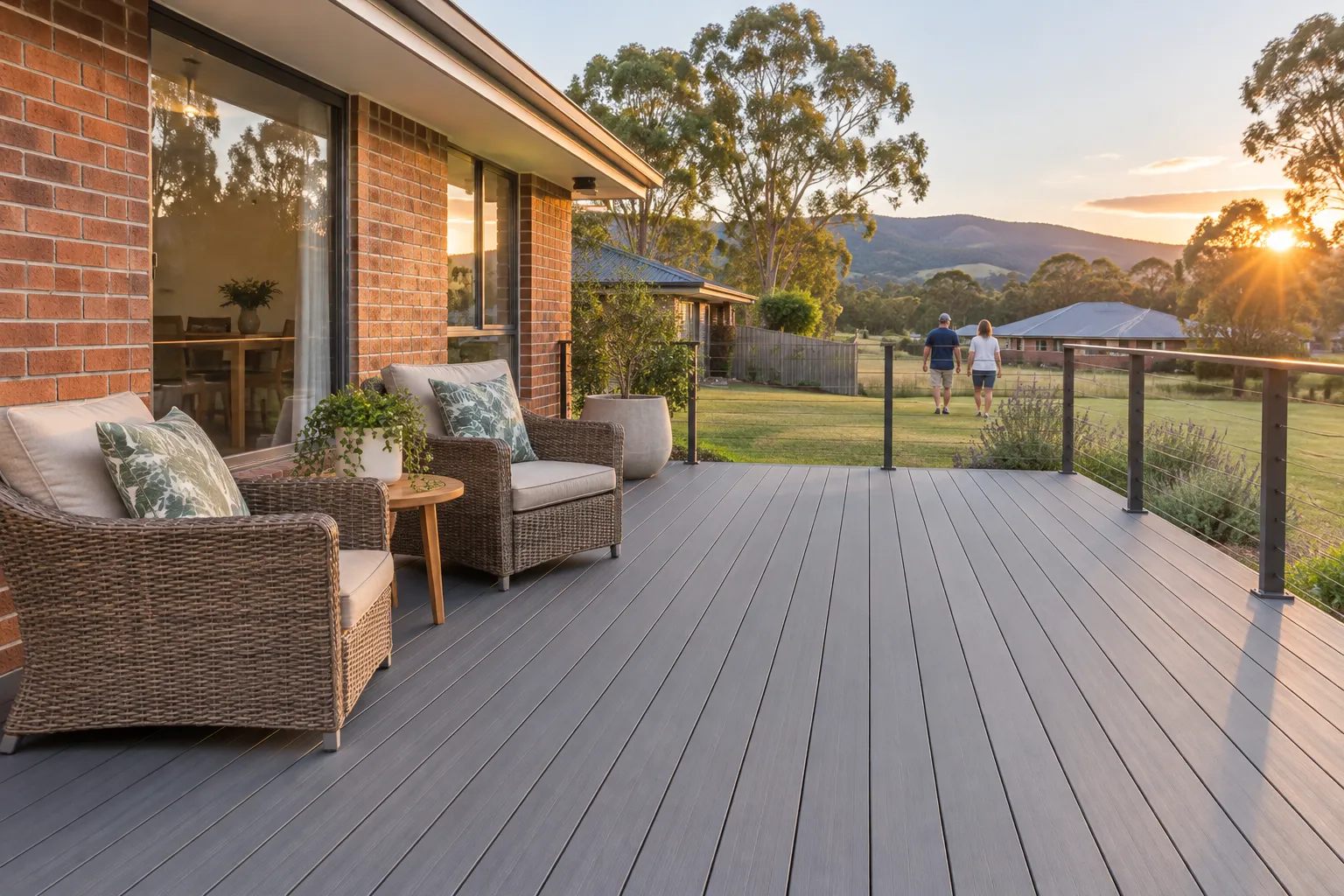
Using published Australian price guides, an installed deck around Albury and Wodonga usually costs about $180 to $350 a square metre in treated pine, $300 to $550 in merbau, $350 to $600 in spotted gum, and $280 to $700 in composite. So a 20 square metre ground-level deck typically lands somewhere between $3,600 and $14,000 depending on the material.
What pushes a deck toward the top of its range:
- Height. Decks more than about 600 millimetres off the ground need more frame, bracing and often a balustrade.
- Slope and access. Steep blocks, rock and tight side access add labour.
- Design. Steps, built-in seating, picture-frame borders and diagonal boards take longer.
- Removing an old deck. Usually priced separately.
- Approval. Fees for a development application or building permit when the deck isn't exempt.
These are guide figures. The builder who visits gives you the real price in writing. For a full breakdown, see deck cost or timber decking cost per square metre. Each material has its own cost page too: composite decking cost, merbau decking cost, spotted gum decking cost and treated pine decking cost.
How much does a 40 m2 deck cost?
A 40 square metre deck is a large deck. Using published price ranges, it usually costs about $7,200 to $14,000 in treated pine, $12,000 to $22,000 in merbau, $14,000 to $24,000 in spotted gum, and $11,200 to $28,000 in composite, installed. Raised decks, stairs and balustrades push those totals up, while a low, simple layout keeps them near the bottom.
| Material | 20 m2 deck | 40 m2 deck |
|---|---|---|
| Treated pine | $3,600 to $7,000 | $7,200 to $14,000 |
| Merbau | $6,000 to $11,000 | $12,000 to $22,000 |
| Spotted gum | $7,000 to $12,000 | $14,000 to $24,000 |
| Composite | $5,600 to $14,000 | $11,200 to $28,000 |
On a bigger deck, the cost of upkeep matters more too: oiling 40 square metres of timber every year or two adds up, which is why many larger decks around Albury and Wodonga are now composite.
What is the most expensive part of a deck?
On most decks, the boards are the single biggest material cost, especially hardwood or premium composite. On raised decks, the frame, footings and balustrade can cost as much as the boards, because there's more structure and more labour. Labour itself is often around half the total. Stairs are expensive for their size, because every tread and stringer is cut and fixed by hand.
Ways to get more deck for the money:
- Keep it low. A deck under about 600 millimetres usually avoids a balustrade.
- Use standard board lengths. Less waste and fewer joins.
- Spend on the frame, save on extras. A sound frame outlasts several sets of boards.
- Look at elevated deck ideas only if the site needs height: it's the biggest cost driver.
Do you need council approval for a deck in Albury or Wodonga?
It depends which side of the river you're on. In NSW, a deck can be exempt development, needing no approval, if it meets every state standard: including a floor no more than 1 metre above ground, a maximum area and height, and sitting behind the building line. In Victoria, the Victorian Building Authority says most decks need a building permit.
In more detail:
- Albury, Lavington, Thurgoona, Jindera, Corowa, Howlong (NSW). Check the deck against the state exempt development rules. If it fails one, it needs a development application or a complying development certificate. Bush fire prone land, flood areas and heritage items can change what's allowed.
- Wodonga, Leneva, Baranduda, Beechworth, Yackandandah, Tallangatta (Victoria). A building permit for most decks. Heritage overlays in Beechworth and Yackandandah can also need a planning permit.
- Licences. In NSW, residential building work over $5,000 must be done by a licensed builder under a written contract.
Our guide on whether you need council approval for a deck walks through each step.
What does the Border's climate mean for your deck?
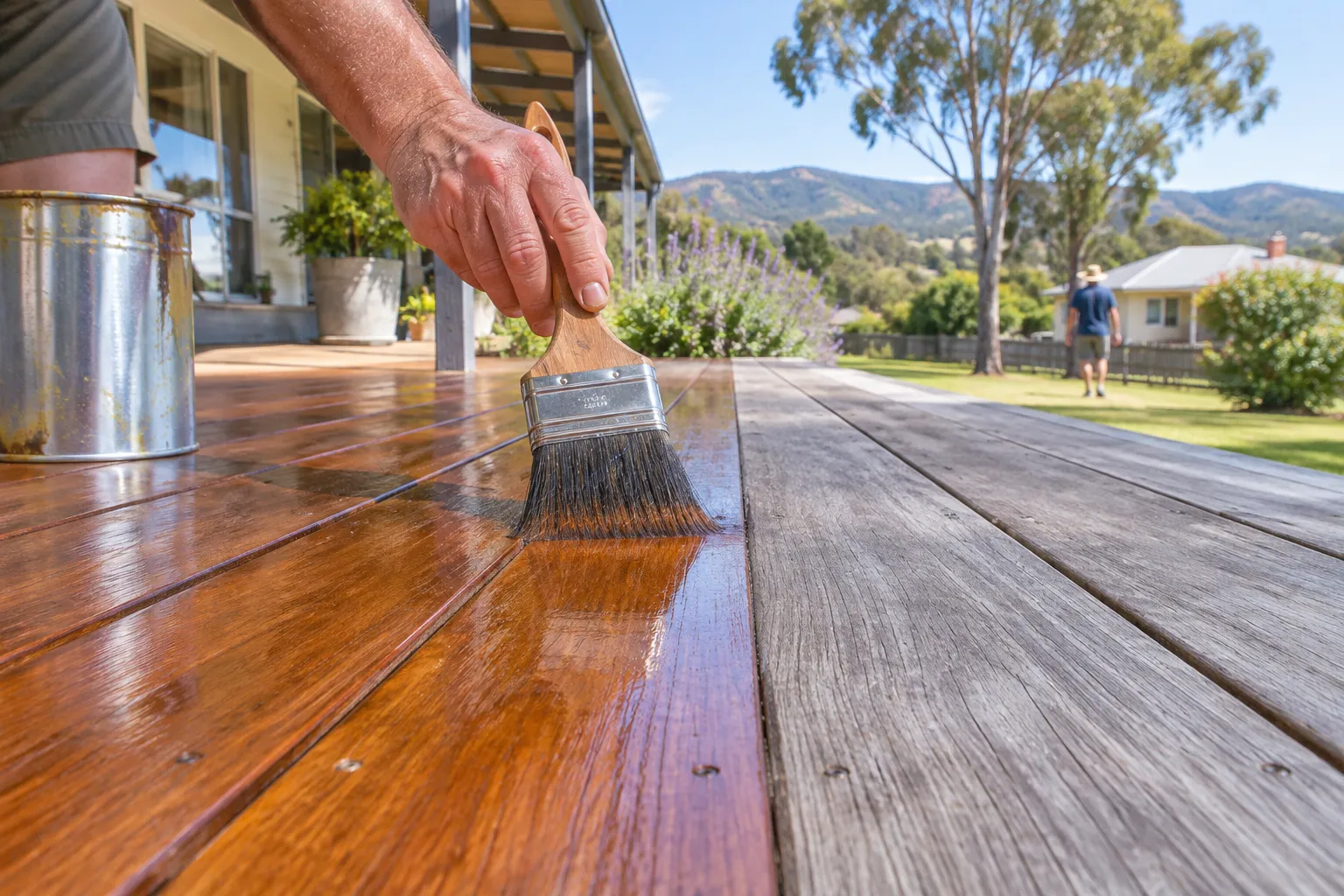
Albury and Wodonga have hot, dry summers, cold frosty winters and reactive clay soils in many suburbs. That means decks here move more than in milder places: boards shrink in summer and swell in winter, dark surfaces get very hot, and footings need to suit soils that swell and shrink. Parts of the area are also mapped as bush fire prone land.
How a good builder plans for it:
- Board gaps sized for the swing between summer and winter.
- Lighter colours or shade on west-facing decks, so they stay usable in January.
- Airflow under low decks, so the frame dries out after winter rain.
- Footings sized for the soil, not a rule of thumb.
- Bushfire-resisting timber or non-combustible materials on mapped blocks. AlburyCity publishes its bush fire prone land map.
Regular oiling makes the most difference to a timber deck's life here. See deck oiling for timing and costs, and how long a wooden deck lasts for what to expect.
Can you build a deck yourself?
Yes, a small, low deck on flat ground is a realistic DIY project if you can set out square, pour footings and use a drill and saw well. Raised decks, sloping blocks, stairs, balustrades and anything needing approval are best left to a builder. In NSW, any paid building work over $5,000 must be done by a licensed builder.
A few pointers if you're going DIY:
- Start small and low. See how to build a deck at ground level.
- Follow a full guide. Our step-by-step on how to build a deck covers footings, frames and boards.
- Use the right materials. H3 or H4 treated pine for frames, depending on clearance, and fixings rated for treated timber.
- Skip the pallets. Pallet timber is usually untreated or treated with chemicals not meant for decks. It rots fast and isn't built to carry people.
- Use a materials calculator to estimate boards, joists and screws, and add about 10% for waste.
What is the 3-4-5 rule for decks?
The 3-4-5 rule checks that a deck frame's corner is square. Measure 3 units along one side and 4 along the other, then measure between the two marks: if it's exactly 5 units, the corner is a right angle. Builders scale it up, for example 1.2, 1.6 and 2 metres, then confirm both full diagonals of the frame are equal.
Do you also arrange pergolas, patios, verandahs and carports?
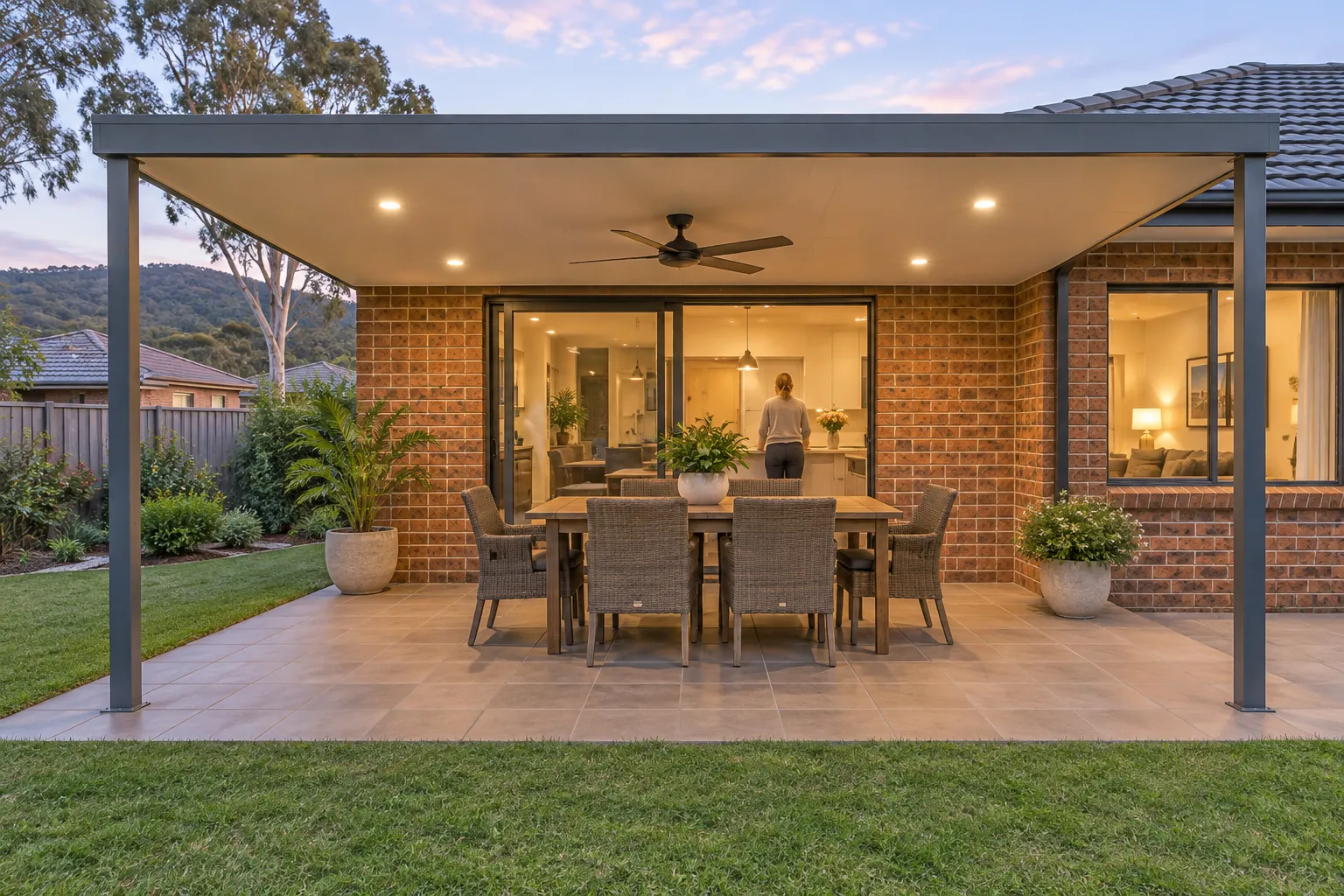
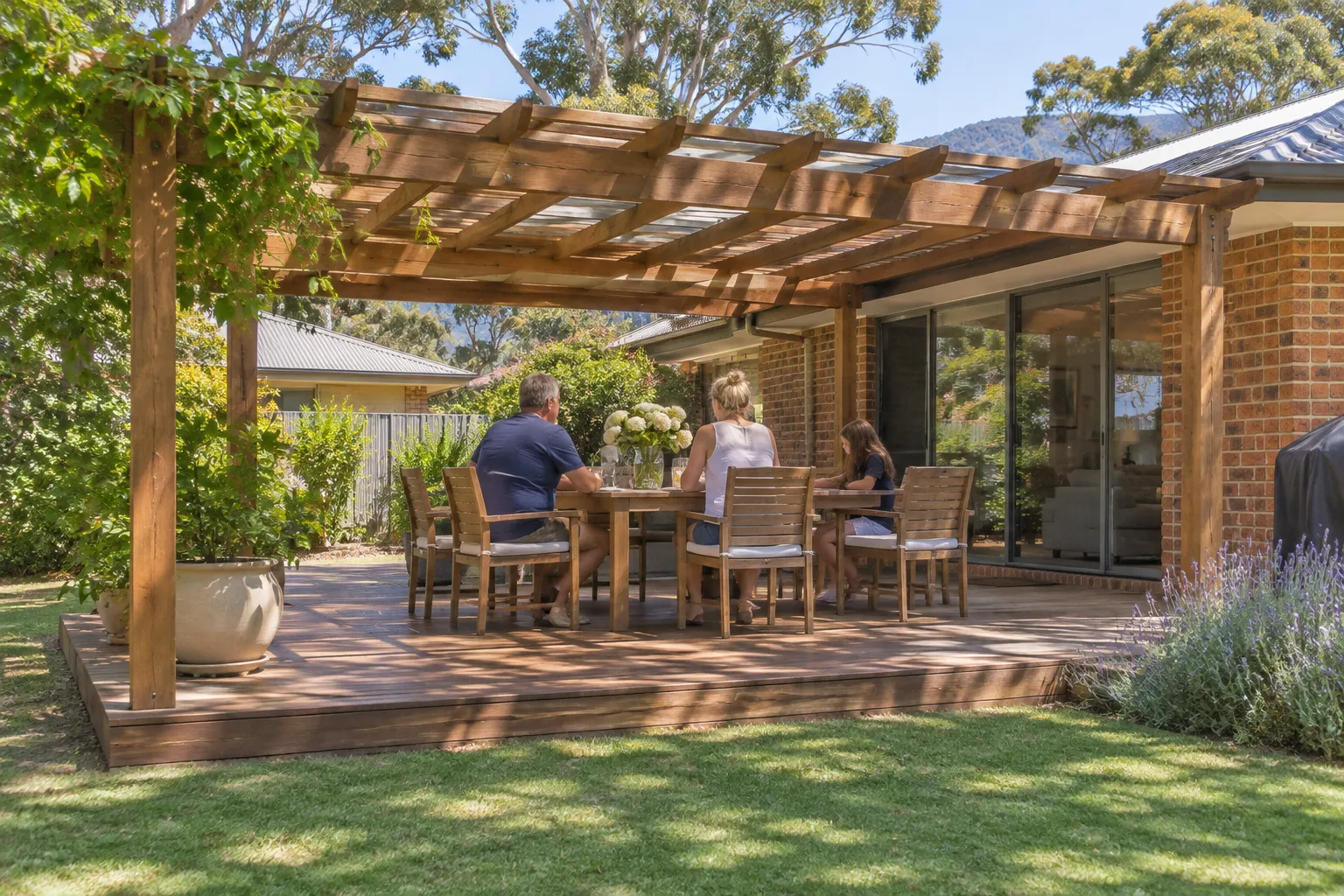
Yes. Most outdoor areas around Albury and Wodonga combine a deck or paving with a roof, so we arrange the whole thing. A local builder can quote the deck and the roof over it together, which usually means a neater design, posts in the right places and better drainage. Each service has its own page with costs and rules.
| Service | Guide cost | Page |
|---|---|---|
| Pergolas | About $3,000 to $25,000 | Deck and pergola builders |
| Colorbond pergolas | About $6,000 to $15,000 | Colorbond pergolas |
| Patios and alfresco roofs | About $200 to $600 per m2 | Deck and patio builders |
| Verandahs | About $200 to $430 per m2 | Verandahs |
| Carports | About $3,500 to $15,000 | Carport builder |
| Pool decks | About $280 to $700 per m2 | Pool decks |
| Deck oiling and restoration | About $15 to $70 per m2 | Deck oiling |
For more cost detail, see pergola cost, patio cost, free standing carports cost, pool decks cost, deck restoration cost and replacing deck cost. For inspiration, browse outdoor living ideas, or try patio kits if you're weighing up a kit.
Which areas around Albury and Wodonga do you cover?
We arrange decks and outdoor structures across Albury, Wodonga and the towns around them, on both sides of the Murray. That includes central and south Albury, East Albury, Lavington, Thurgoona, Splitters Creek and Jindera on the NSW side, and Wodonga, Leneva and Baranduda, Beechworth, Yackandandah and Tallangatta on the Victorian side, plus Corowa and Howlong downriver.
Each area page covers what's different there, such as flood mapping in South Albury, bushfire mapping in Thurgoona and Splitters Creek, the new estates in Leneva and Baranduda, and the heritage overlays in Beechworth and Yackandandah. See all local areas, or browse our decking guides and articles.
Questions people ask
How long does it take to build a deck?
A simple ground-level deck of 15 to 25 square metres usually takes a builder three to six working days once materials are on site. Raised decks, stairs, balustrades, a roof and approvals all add time, and wet weather slows footings. The builder gives you a timeframe with the written quote, so you can plan around it.
What should you ask before hiring someone to build a deck?
Ask what the frame is made of and how it's protected, what board and fixings they'll use, what gap they'll leave between boards, whether it needs approval and who arranges it, and what's included in the price. Ask for the quote in writing. In NSW, check the builder holds a licence for work over $5,000.
Do you need to be home while a deck is built?
Usually only at the start and the end. On day one, the builder confirms the layout, levels and step positions with you. At the end, you walk through the finished deck together. In between, they need access to the site, power and somewhere to stack materials. Agree on gates, pets and parking before work begins.
How long does a timber deck last in Albury and Wodonga?
A well-built hardwood deck with a sound frame, good airflow and regular oiling can last 20 years or more above ground, and treated pine decks commonly last 15 to 20 years. Frames and fixings often fail before the boards. Neglect shortens it most: a deck that's never oiled and sits low over damp ground wears out far sooner.
Is composite or timber better for a deck on the Border?
Neither is better for everyone. Composite needs no oiling, won't rot and suits pools, but costs more and dark colours get hot. Hardwood looks natural, stays cooler when pale, can be sanded back and suits bushfire areas when it's a listed species. Your budget, how much upkeep you'll do and your block's bushfire rating usually decide it.
Can a new deck be built over an old one?
Usually not directly. The old deck's boards come off, and the frame is checked. If the frame is sound, level and at the right joist spacing, new boards can go on it, which saves money. If it's soft, sagging or termite damaged, it's replaced. A builder checks it on the site visit and quotes both options where it makes sense.
Deck builder in Albury
- Composite decking
Composite decking in Albury and Wodonga explained.
- Pergolas
Pergola builders across Albury and Wodonga.
- Deck oiling, staining and restoration
Deck oiling and restoration around Albury and Wodonga.
- Carports
Carports for Albury and Wodonga homes. Single and double sizes, what an installed carport costs, footings, NSW and Victorian approval…
- Verandahs
Verandahs for Albury and Wodonga homes. Flat, skillion and gable styles, what an installed verandah costs per square metre, permits in NSW…
- Deck prices
What a deck costs in Albury and Wodonga in 2026.
- Best timber for a deck
Which timber decking suits an Albury deck: spotted gum, blackbutt, merbau, ironbark, jarrah and treated pine compared on durability,…
- Permits for deck repairs
When deck repairs need approval in NSW and Victoria: like-for-like board repairs, structural repairs, rebuilding, raising or extending a…
- Council approval for a deck
When a deck needs council approval in Albury (NSW) and Wodonga (Victoria).
- Elevated deck ideas
Elevated deck ideas for sloping blocks and raised homes: multi-level decks, under-deck space, balustrades, stairs, covered decks, views,…
- How long a timber deck lasts
How long a timber deck lasts in Albury: treated pine vs hardwood, durability classes, why frames fail first, signs it's near the end, and…
- Building a ground-level deck
How to build a low, ground-level deck in Albury: preparing the ground, low-profile frames, H4 timber and airflow, decks over concrete…
- How a deck is built
How to build a timber or composite deck, step by step: planning, approval, footings, frame, boards and stairs, with the rules that apply…
- Outdoor living ideas
Outdoor living ideas for Albury and Wodonga homes: decks, covered patios, pergolas, outdoor kitchens, fire pits, shade for hot summers,…
- Repair or replace boards
How to decide whether to repair or replace deck boards: checking boards and frame, which problems can be fixed, matching boards and costs.
- Termites in a deck
Signs of termites in a timber deck: mud tubes, hollow timber, soft joists, damage patterns, why decks attract termites, and what to do if…
- Timber decking balustrade
Timber deck balustrades in Albury: when the building code requires one, minimum height, 125 mm gaps, climbable rails on high decks, timber…
- Timber decking board
Timber decking boards explained: smooth vs reeded profiles, nominal vs actual sizes, grades, lengths, moisture, buying enough, storing…
- Timber decking per square metre
Timber decking cost per square metre compared: treated pine, merbau, spotted gum and other hardwoods, what's included in the figure,…
- Colorbond pergolas
Colorbond pergolas for Albury and Wodonga backyards.
- Composite decking installation
How composite decking is laid, step by step: frame, joist spacing, clips, gaps and ventilation.
- Patios and alfresco roofs
Deck and patio builders for Albury and Wodonga homes.
- Merbau decking
Merbau decking for Albury and Wodonga homes.
- Patio kits
Patio kits compared with a custom-built patio for Albury and Wodonga homes.
- Pool decks
Pool decks for Albury and Wodonga homes. Timber, composite and paving options, decks around above-ground pools, pool fence rules, costs…
- Spotted gum decking
Spotted gum decking for Albury and Wodonga homes.
- Deck framing, joists and footings
Steel deck framing for Albury and Wodonga homes.
- Treated pine decking
Treated pine decking for Albury and Wodonga homes.
- Composite decking cost
Composite decking costs in Albury and Wodonga for 2026.
- Deck restoration cost
What deck restoration costs in Albury and Wodonga.
- Freestanding carport cost
What a freestanding carport costs in Albury and Wodonga.
- Merbau deck cost
What a merbau deck costs in Albury and Wodonga in 2026.
- Patio cost
What a patio costs in Albury and Wodonga in 2026.
- Pergola cost
Pergola costs in Albury and Wodonga for 2026.
- Pool deck cost
What a pool deck costs in Albury and Wodonga.
- Deck replacement cost
What replacing a deck costs in Albury and Wodonga.
- Spotted gum deck cost
What a spotted gum deck costs in Albury and Wodonga in 2026.
- Steel deck framing cost
What steel deck framing costs in Albury and Wodonga.
- Treated pine deck cost
What a treated pine deck costs in Albury and Wodonga in 2026.
Where these facts come from
- NSW Planning Portal, exempt development for balconies, decks and patios
- Victorian Building Authority, landscaping and outdoor structures
- NSW Government, checking your contractor is qualified
- Business Queensland, spotted gum timber properties
- Queensland Government timber database, merbau fact sheet
- WoodSolutions, preservative treatments and use classes
- AlburyCity, bush fire prone land
- Published installed decking, pergola and patio prices from four Australian cost guides, checked November 2026
Updated