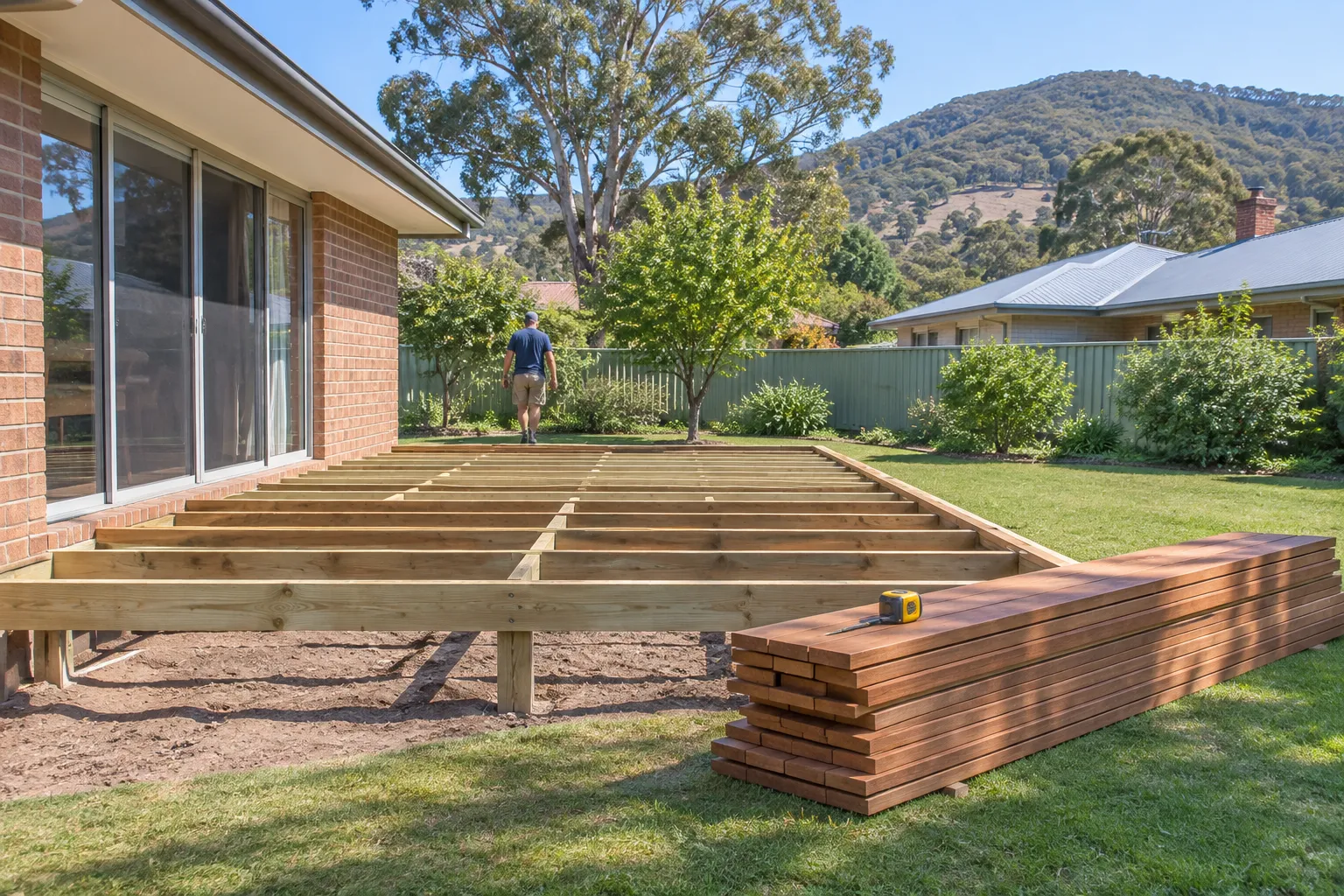
In 2026, an installed deck around Albury and Wodonga usually costs about $180 to $350 a square metre in treated pine, $300 to $600 in hardwood such as merbau or spotted gum, and $280 to $700 in composite, based on published Australian price guides. A typical 20 square metre backyard deck at ground level lands somewhere between about $3,600 and $14,000. Height, slope, stairs and the board you choose move it most. This page breaks the cost down so you can plan, and our Albury deck builder home page covers the services and how a quote works. When you're ready, we'll arrange a visit and a local deck builder gives you a written price.
What does a deck cost per square metre?
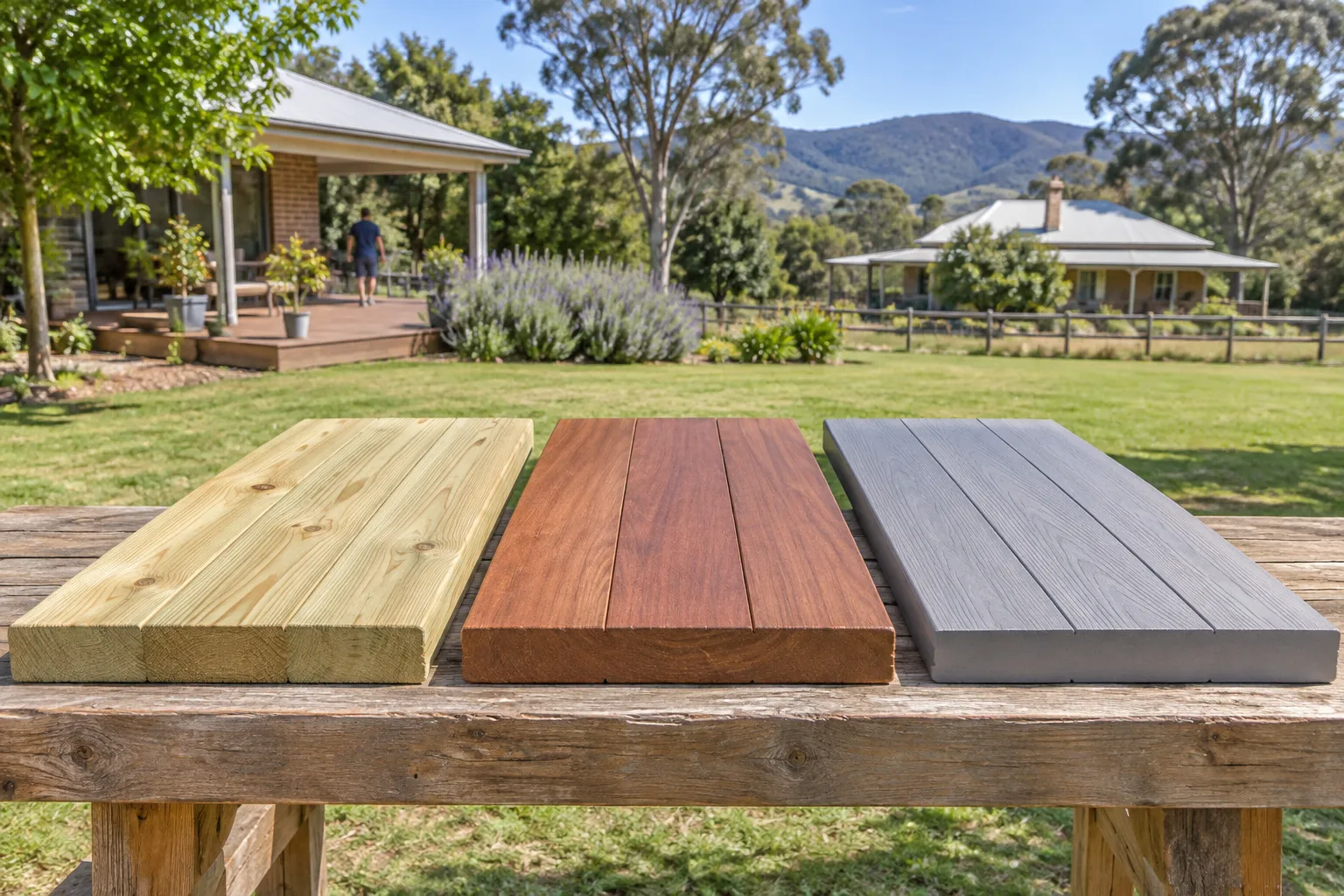
Per square metre, installed, published Australian guides put treated pine decks at about $180 to $350, merbau at about $300 to $550, spotted gum at about $350 to $600, and composite at about $280 to $700. Those figures usually include the frame, boards, fixings and labour on a straightforward, low deck. Extras such as stairs, balustrades and demolition are priced on top.
| Material | Per m2 installed | Per square foot (approx.) |
|---|---|---|
| Treated pine | $180 to $350 | $17 to $33 |
| Merbau | $300 to $550 | $28 to $51 |
| Spotted gum | $350 to $600 | $33 to $56 |
| Composite | $280 to $700 | $26 to $65 |
Square foot figures are converted from the metric ranges (one square metre is about 10.8 square feet), for anyone working from overseas plans. Each material has its own page: treated pine decking cost, merbau decking cost, spotted gum decking cost and composite decking cost.
How much does a 20, 30 or 40 m2 deck cost?
Multiplying the per square metre ranges by size gives a useful first budget. A 20 square metre deck is roughly $3,600 to $14,000 depending on material, 30 square metres roughly $5,400 to $21,000, and 40 square metres roughly $7,200 to $28,000. Those totals assume a low, simple deck. Raised decks and stairs push them higher.
| Size | Treated pine | Hardwood | Composite |
|---|---|---|---|
| 13 m2 (about 12 x 12 ft) | $2,300 to $4,600 | $3,900 to $7,800 | $3,600 to $9,100 |
| 20 m2 | $3,600 to $7,000 | $6,000 to $12,000 | $5,600 to $14,000 |
| 30 m2 | $5,400 to $10,500 | $9,000 to $18,000 | $8,400 to $21,000 |
| 37 m2 (about 20 x 20 ft) | $6,700 to $13,000 | $11,100 to $22,200 | $10,400 to $25,900 |
| 40 m2 | $7,200 to $14,000 | $12,000 to $24,000 | $11,200 to $28,000 |
Hardwood is shown as one range from merbau's low end to spotted gum's high end.
What extras add to the cost of a deck?
The extras that add most are height, stairs, balustrades, removing an old deck, a steel frame, and approval fees. Published guides put demolition and disposal at about $20 to $55 a square metre, decks over 600 millimetres high at about $50 to $120 a square metre extra, and a steel or aluminium sub-frame at roughly $60 to $120 a square metre over timber.
A checklist of what may or may not be in a quote:
- Removing the old deck. About $20 to $55 per m2 in published guides.
- Height. Extra bracing, posts and a balustrade above about 600 mm.
- Stairs. Priced per step or as a set, and costly for their size.
- Balustrades. Timber, glass, wire or aluminium, each with its own cost. See timber decking balustrade.
- Steel frame. Roughly $60 to $120 per m2 extra. See steel deck framing cost.
- Flashing to the house. Where a deck meets a wall or a door, flashing keeps water out of the house frame.
- Approval. A development application in NSW or a building permit in Victoria if the deck isn't exempt.
- Oil or stain. Some quotes include the first coats, many don't.
Is a deck cheaper than a concrete slab?
On flat, level ground, a plain concrete slab or pavers is usually cheaper than a timber or composite deck of the same size. On a sloping block, or where you want the floor level with the back door, a deck often works out cheaper, because building a slab up to height needs retaining walls and fill. A deck also lets water drain and air move underneath.
The right choice often comes down to the site:
- Flat ground, at ground level. A slab or pavers, perhaps with a patio roof over it. See deck and patio builders.
- A slope or a raised back door. A deck, usually.
- Over an old slab. A low-profile deck frame can sit on the slab, if water can drain.
What is the cheapest type of decking?
Treated pine is the cheapest type of decking to build, at about $180 to $350 a square metre installed in published guides. It's softer than hardwood and needs oiling more often, but it's easy to work and widely available. Over 10 to 20 years, composite can work out cheaper than pine once you count the oil, sanding and board replacement pine needs.
If the cheapest upfront deck is the goal: keep it low, stay square and rectangular, use standard board lengths, and skip built-in extras for now. You can add a pergola or seating later. For DIY, our guide on how to build a deck covers the steps.
How do you work out a deck budget before getting quotes?
Start with the area: length times width in metres. Multiply it by the per square metre range for the material you like, then add any extras: stairs, a balustrade, demolition, a steel frame. Add about 10% for surprises. That gives a realistic range to compare quotes against, and a written quote after a site visit gives you the real figure.
A worked example: a 5 by 6 metre spotted gum deck at ground level is 30 square metres. At $350 to $600 a square metre, that's about $10,500 to $18,000. Add three steps and old deck removal, and plan on the upper half of that range.
In NSW, residential building work over $5,000 must be done by a licensed builder under a written contract, and Fair Trading publishes a standard contract for jobs up to $20,000. Compare quotes on what's included, not only the total.
Questions people ask
How do you calculate how much decking to buy?
Measure the deck's length and width in metres and multiply them to get the area. Divide by the board's cover width (the board width plus the gap) to get the number of board rows, then multiply by the deck length for total lineal metres. Add about 10% for offcuts and waste. Decking calculators on supplier websites do this for you, and our guide to timber decking boards covers sizes.
How much does 30 m2 of decking cost?
Using published price ranges, 30 square metres of installed decking costs about $5,400 to $10,500 in treated pine, about $9,000 to $18,000 in merbau or spotted gum, and about $8,400 to $21,000 in composite. Those are for a low, simple deck. Height, stairs and demolition add to it. A written quote after a site visit gives the real number.
What is the 3-4-5 rule for a deck?
It's a way to check a deck frame's corner is square. Mark 3 units on one side and 4 on the other, and the distance between the marks should be exactly 5. If it's not, the frame is out of square. It costs nothing to check and saves boards running crooked across the deck.
What are the standard sizes for decking joists?
Common treated pine joist sizes in Australia are 90 by 45, 140 by 45 and 190 by 45 millimetres, usually spaced at 450 millimetres for hardwood boards and closer for some composites. The size you need depends on the span, the timber grade and the spacing, set from span tables. Steel joists use their own tables.
Does a deck add value to a house?
A well-built deck can make a home more liveable and appealing to buyers, especially with Albury's long summers. How much value it adds depends on the house, the build quality and the market, so there's no fixed figure. A deck that needed approval should have it, or it can cause problems when you sell.
Where these facts come from
- NSW Planning Portal, exempt development for balconies, decks and patios
- Victorian Building Authority, landscaping and outdoor structures
- NSW Fair Trading, home building contract for work from $5,000 to $20,000
- Published installed decking prices from four Australian cost guides, checked November 2026
Updated