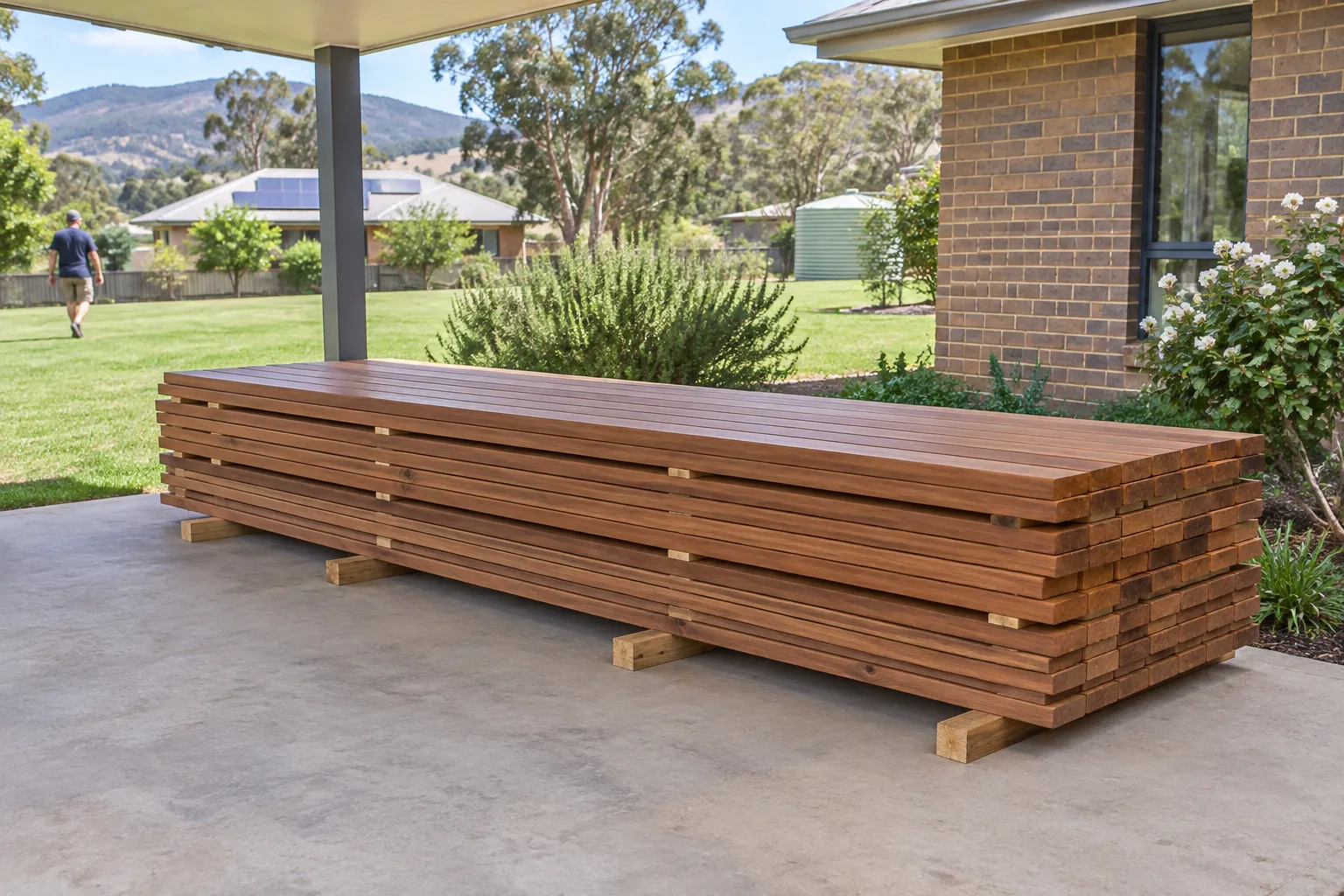
A timber decking board is a dressed length of hardwood or treated pine made for outdoor floors, usually 19 millimetres thick in hardwood or 22 in pine, in widths from about 70 to 140 millimetres. Boards vary by profile (smooth or reeded), grade (how many natural marks), moisture content and length. Getting the right profile, grade and moisture for your deck, and buying enough in one order, makes a big difference to the finished result. For costs and how we arrange a builder, see our Albury deck builder home page.
What profiles do decking boards come in?
Decking boards usually come with a smooth face, a reeded or grooved face, or both, one on each side. Most people lay the smooth face up for a clean look and easy cleaning. Reeded faces add a little grip but trap dirt and water in the grooves. Many boards also have slightly rounded edges, called pencil-rounded, to reduce splinters.
| Profile | Look | Practical notes |
|---|---|---|
| Smooth | Clean, modern | Easy to clean and oil |
| Reeded or grooved | Textured | Holds dirt and water |
| Pencil-rounded edges | Softer edges | Fewer splinters at edges |
What do decking board grades mean?
Grades describe a board's appearance: how many knots, gum veins, colour changes and other natural features it has. Higher grades, often called select, look cleaner. Standard and feature grades have more character and cost less. The grade doesn't change the timber's durability, which comes from the species and heartwood.
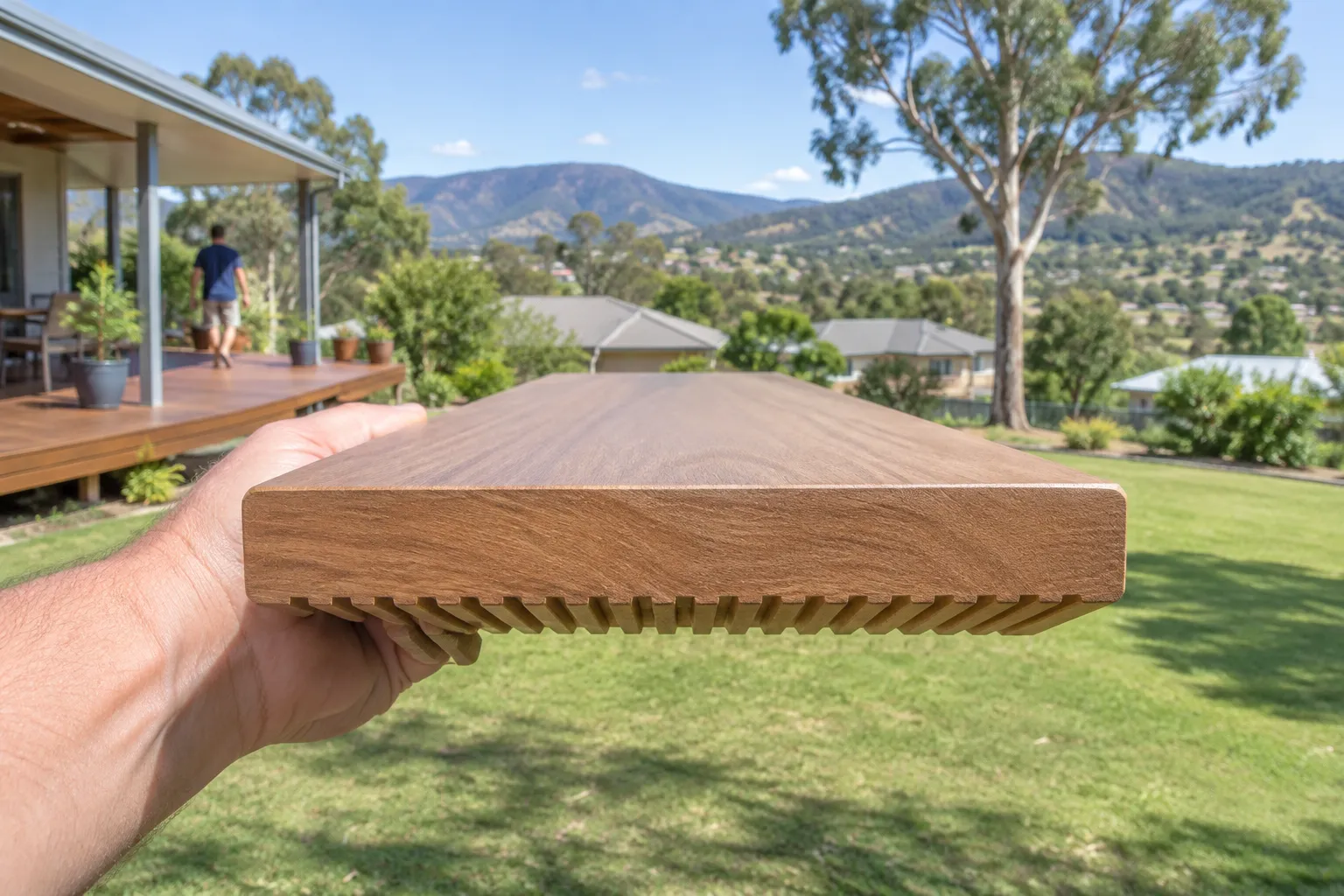
See spotted gum decking sizes for grades on one species.
What sizes are decking boards?
Hardwood decking boards are commonly 19 millimetres thick and about 70, 86 or 90, and 135 or 140 millimetres wide. Treated pine boards are usually 22 millimetres thick and 70, 90 or 140 millimetres wide. These are nominal sizes: the dressed board is often a little smaller. Lengths are usually random, from about 1.8 to 6 metres.
See merbau decking dimensions and treated pine decking sizes.
Why does moisture content matter?
Timber shrinks as it dries and swells as it takes up moisture. Boards delivered wet will shrink after laying, opening the gaps. Very dry boards will swell in Albury's wet winters, closing the gaps if they were laid too tight. Knowing roughly how dry the boards are lets the builder set the right gap. Treated pine often arrives wet from treatment.
Ask the supplier about moisture, and let boards acclimatise on site, stacked off the ground and under cover, before laying.
How many decking boards do you need?
Divide 1,000 by the board width plus the gap, in millimetres, to get lineal metres per square metre, then multiply by the deck area and add about 10% for waste. Buy all the boards in one order, because colour and dimensions can vary slightly between batches, and having to match a second batch later can be hard.
How should decking boards be stored before laying?
Stack boards flat on bearers off the ground, with spacers between layers so air can move, and cover them from rain and direct sun, while letting air circulate. Don't leave them lying on grass or soil. Stored this way, they stay straight and adjust to local conditions, which reduces movement after the deck is built.
How are timber decking boards fixed?
Usually with two decking screws per board at every joist, pre-drilled near the ends on hardwood to stop splitting. Use stainless steel screws for tannin-rich timbers like merbau, and hot-dipped galvanised or stainless fixings for treated pine. Hidden clip systems for hardwood are an alternative to face screws. Every board join should land on a joist.
See how to build a deck and best timber decking.
Questions people ask
Which side of a decking board goes up?
Most people lay the smooth side up, because it looks cleaner and is easier to clean and oil. The reeded side gives a little more grip but holds dirt and water. If a board has a slight curve across its width, builders often lay it so it sheds water. Check the supplier's advice.
What is the standard thickness of decking boards?
Hardwood decking boards are usually 19 millimetres thick, and treated pine boards usually 22 millimetres, because pine is softer. Thicker boards, around 25 to 32 millimetres, are used for stair treads and wider joist spacing. Thickness affects how far boards can span between joists.
Do timber decking boards need to be treated?
Durable hardwoods like spotted gum, blackbutt and merbau are used untreated above ground, because they're naturally durable. Pine must be treated, usually to H3 for decking boards. Any timber in or near the ground needs higher durability or treatment, such as H4 or H5.
Can you buy decking boards in long lengths?
Many suppliers stock boards up to about 5.4 or 6 metres, and some longer, depending on the species and grade. Longer boards mean fewer joins, which looks cleaner. Long lengths can cost more per metre and may need ordering in. Plan the deck around available lengths to reduce waste.
Where these facts come from
Updated