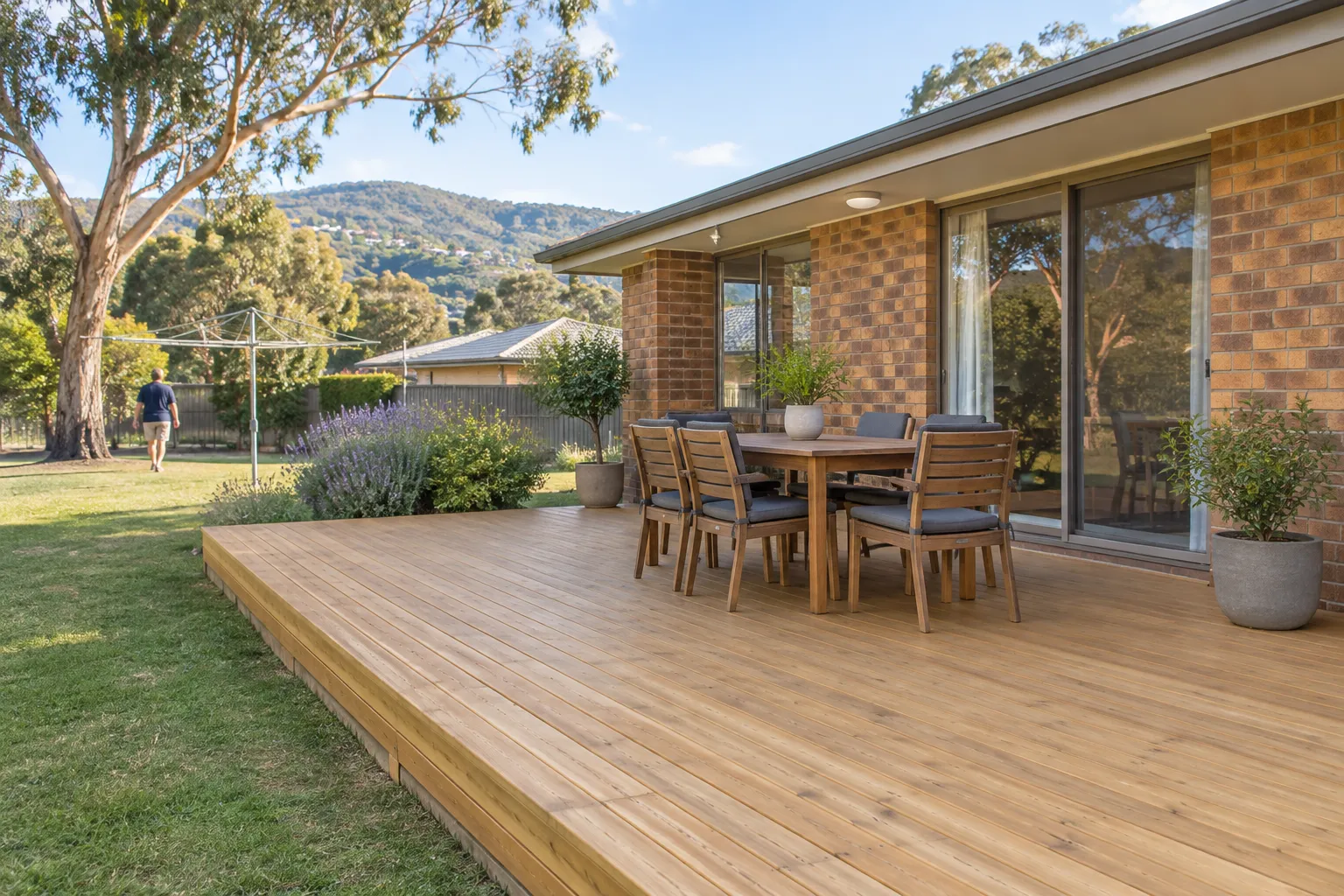
Treated pine decking is softwood pine that's been pressure-treated with a preservative so it resists rot and termites outdoors. It's the cheapest way to build a timber deck: published Australian guides put an installed treated pine deck at about $180 to $350 a square metre. Pine is softer than hardwood and needs regular oiling, but built well it lasts years in Albury's climate. This page covers H3 versus H4, board and frame sizes, how long a pine deck lasts and what to ask a builder. If you want one built, we'll arrange a visit and a local deck builder comes to you with a written quote.
Can you use pine to build a deck?
Yes, as long as it's the right treated pine for each part. Untreated pine rots quickly outside. For decking boards and frames above ground with good airflow, use H3 treated pine. For decks close to the ground or anything in contact with soil, step up to H4 or H5. Every treated pine piece should carry a stamp or tag showing its hazard class.
What a typical treated pine deck uses:
| Part | Usual treatment | Why |
|---|---|---|
| Decking boards, well ventilated | H3 | Above ground, gets wet and dries |
| Joists and bearers, well clear of the ground | H3 | Above ground, protected |
| Frames on low decks, under 400 mm clearance | H4 | Damp, poor airflow |
| Posts and stumps in the soil | H5 (or H4 in some guidance) | In-ground contact |
WoodSolutions says decks with less than 400 millimetres of clearance should use H4 treated pine or a class 1 hardwood, because the timber stays damp for longer.
Which is better, H4 or H3 treated pine?
Neither is better overall: they're made for different conditions. H3 is for timber above ground that gets wet and dries out, like boards and most joists. H4 has more preservative and is for timber that stays damp, like low frames near the soil or fence posts. Using H4 where H3 is enough costs more without much benefit. Using H3 where H4 is needed shortens the deck's life.
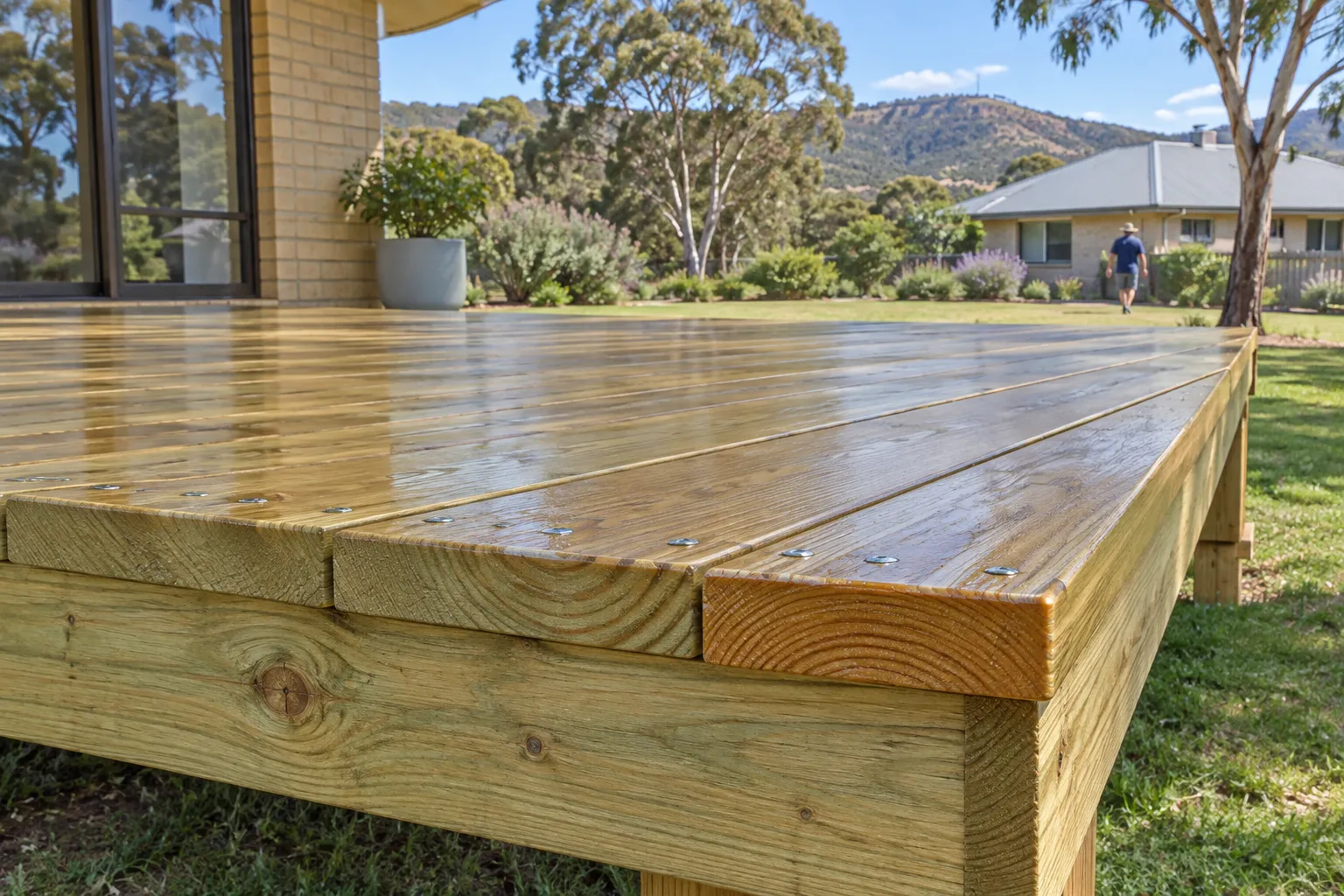
A few things to know about treated pine around Albury:
- CCA is off the table for decks. The national regulator cancelled the use of copper chrome arsenate (CCA) for domestic decking, handrails and outdoor seating. Modern decking pine uses arsenic-free treatments such as copper azole or ACQ.
- Check the tag. Treated timber should be marked with its hazard class and the standard, AS/NZS 1604.
- Cut ends need sealing. Cutting exposes untreated timber inside. An end-seal product brushed on every cut keeps the treatment intact.
- Fixings matter. Copper-based treatments can corrode plain steel. Use hot-dipped galvanised or stainless fixings rated for treated timber.
What sizes do treated pine decking boards come in?
The most common treated pine decking boards are 90 by 22 millimetres and 70 by 22 millimetres, with 140 by 22 millimetre boards for a wider look. Pine boards are usually 22 millimetres thick, a little thicker than the 19 millimetres common for hardwood, because pine is softer. Lengths run from about 1.8 to 6 metres.
| Board | Look | Notes |
|---|---|---|
| 90 x 22 mm | Classic | The most common, good balance of speed and stability |
| 70 x 22 mm | Fine, traditional | Most stable, slowest to lay |
| 140 x 22 mm | Wide, modern | Faster, but moves and cups more |
Some boards have a reeded (grooved) face on one side. People often lay them smooth side up for a cleaner look. See treated pine decking sizes for grades and lengths.
What size bearers and joists does a deck need in Australia?
Bearer and joist sizes come from span tables, based on the timber's grade, the spacing and how far each piece spans. A common treated pine setup uses 90 by 45 or 140 by 45 millimetre joists at 450 millimetre centres, on bearers of 140 by 45 doubled or bigger. Longer spans need deeper timber or more posts.
The right size for your deck depends on:
- The grade. Structural pine is graded, often MGP10 or MGP12. Higher grades span further.
- Joist spacing. Closer joists can span further and suit thinner boards.
- Single or continuous span. A joist running over three supports carries more than one running over two.
- The load. A deck carrying a spa or planter boxes needs a stronger frame.
How far can a 140 x 45 joist span on a deck?
It depends on the grade of timber, the joist spacing and whether it's a single or continuous span, so there isn't one number. Treated pine suppliers publish span tables for each grade, and the Australian timber framing standard sets the rules. A builder sizes the frame from those tables, not from a rule of thumb.
If you're building it yourself, use the span table from the supplier of the timber you're buying, and check whether your deck needs approval. In NSW, a deck is only exempt development if it meets all the state standards, including a floor no more than 1 metre above ground. See how to lay treated pine decking for the DIY steps.
How long does a treated pine deck last?
A well-built treated pine deck commonly lasts around 15 to 20 years, and longer when it's kept oiled, well ventilated and clear of the soil. Decks that sit low, trap leaves or never get oiled wear out much sooner. Boards usually fail before the frame. Replacing worn boards on a sound frame is often much cheaper than a new deck.
How to get the most life from a pine deck in Albury:
- Oil it. A coat every 12 to 24 months keeps water out and slows cracking. The best finish for treated pine decking guide compares options.
- Let it breathe. Keep vents and the sides of low decks open.
- Keep it clean. Sweep leaves from the gaps so water drains.
- Fix problems early. Lifted nails and soft boards are cheaper to fix now than later.
Unoiled pine weathers to a silvery grey and checks on the surface. That's normal, but it shortens the life of the boards.
What does a treated pine deck cost in Albury?
Published Australian price guides put an installed treated pine deck at about $180 to $350 a square metre. A 20 square metre deck at ground level often costs around $3,600 to $7,000. Height, stairs, balustrades and sloping ground push it up. It's usually the cheapest timber, though hardwood and composite can cost less to look after over time.
See treated pine decking cost for a breakdown by size. The builder who visits gives you the real price in writing. If you're weighing up low upkeep, compare it with composite decking.
Questions people ask
What is the 3-4-5 rule for decking?
It's a quick check that a deck frame is square. Mark 3 units along one side from a corner and 4 along the other. If the diagonal between the marks is exactly 5 units, the corner is 90 degrees. Use 600, 800 and 1,000 millimetres or larger for big frames, then check both full diagonals match.
How long does it take to build a treated pine deck?
A simple ground-level treated pine deck of 15 to 20 square metres often takes a builder two to four working days once footings are in. Pine is quicker to cut and fix than hardwood. Raised decks, stairs, balustrades and approvals add time, and wet weather slows footings. The builder gives you a timeframe with the quote.
What should you ask before hiring someone for a treated pine deck?
Ask what hazard class they'll use for the boards, the frame and the posts, how they'll seal cut ends, which fixings they use, and how much clearance and airflow the deck will have. Ask whether it needs council approval. In NSW, residential building work over $5,000 must be done by a licensed builder under a written contract.
Is treated pine safe for a deck where children play?
Treated pine sold for decking today doesn't use CCA, which the national regulator cancelled for domestic decking, handrails and outdoor seating. Check the label or ask the supplier which treatment it uses. If you're replacing an old deck that may be CCA treated, don't burn the offcuts. The NSW EPA explains how to handle and dispose of it.
In this section
- Best finish for treated pine
Choosing a finish for treated pine decking: clear oils, tinted oils, semi-transparent and solid stains, paint, and which lasts and looks…
- Laying treated pine decking
How to lay treated pine decking boards: checking the frame, spacing, which face up, fixings for treated timber, sealing cut ends, joins…
- Treated pine deck cost
What a treated pine deck costs in Albury and Wodonga in 2026.
- Treated pine decking sizes
Treated pine decking sizes: 70, 90 and 140 mm boards at 22 mm thick, lengths, frame timber sizes, coverage per square metre and which size…
More services are listed on deck builder across Albury.
Where these facts come from
- WoodSolutions, preservative treatments and use classes
- NSW EPA, copper chrome arsenate treated timber
- NSW EPA, treated timber codes, labels and branding
- Business Queensland, using treated timber
- Published installed decking prices from three Australian cost guides, checked November 2026
Updated