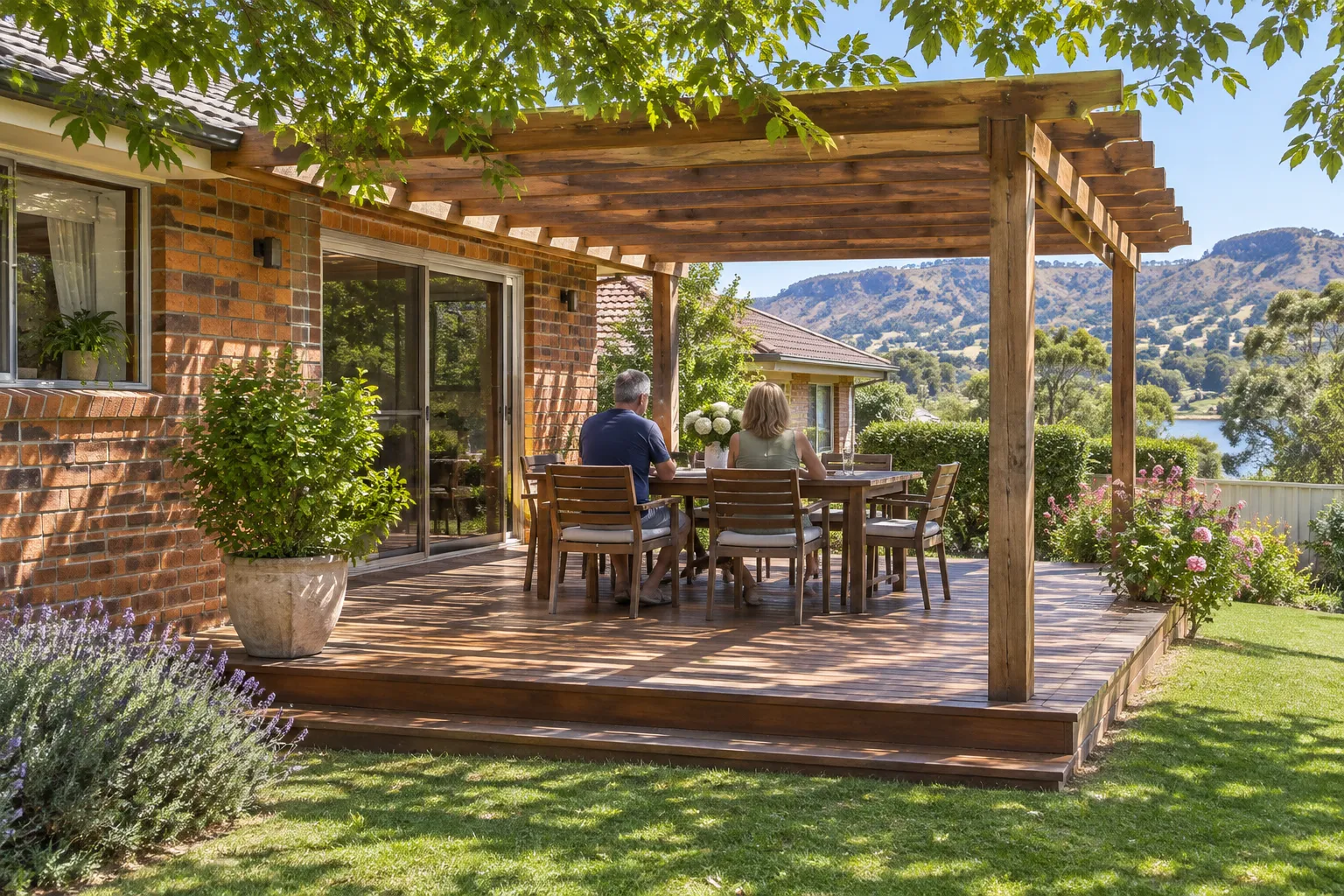
If you're looking for deck and pergola builders around Albury and Wodonga, the short answer is this. A built pergola usually costs about $3,000 for a small open timber frame and up to $25,000 or more for a large insulated roof, and many smaller pergolas don't need council approval if they meet the state rules. We arrange it simply. Tell us what you want, we'll arrange a visit, and a local builder comes to you, measures up and gives you a written quote before any work starts. This page covers kits versus a custom build, roofs, timber sizes, fences and approval.
Should you buy a pergola kit or have one built?
A kit makes sense for a small, simple, freestanding pergola on flat ground where you're happy to do the work. A custom build makes more sense when the pergola attaches to the house, has a roof, sits on a slope or needs to match an existing deck. Kits save on design, not always on labour, and they still need footings set correctly.
Kits come in timber, steel and aluminium, and Stratco and other suppliers sell them through local stores. What a kit includes varies a lot:
- Frame only. Posts, beams and rafters, cut to size. You supply footings, fixings and the roof.
- Frame and roof. Adds roof sheets or polycarbonate, gutters and flashings.
- Louvred kits. Adjustable blades for shade or rain. More parts, more care in setting out. See our guide to a DIY louvred pergola kit.
A builder can also put up a kit you've bought. That's often a good middle path. If you're comparing kit prices, the Stratco pergola price list guide shows what affects them.
Can I build a pergola myself?
Yes, a simple freestanding timber pergola is a reasonable DIY job if you're handy with a drill, a level and a concrete mix. Attached pergolas, roofed pergolas and anything on a slope are harder, because the fixing to the house, the roof fall and the footings all need to be right. In NSW, paid building work over $5,000 must be done by a licensed builder.
The parts people underestimate:
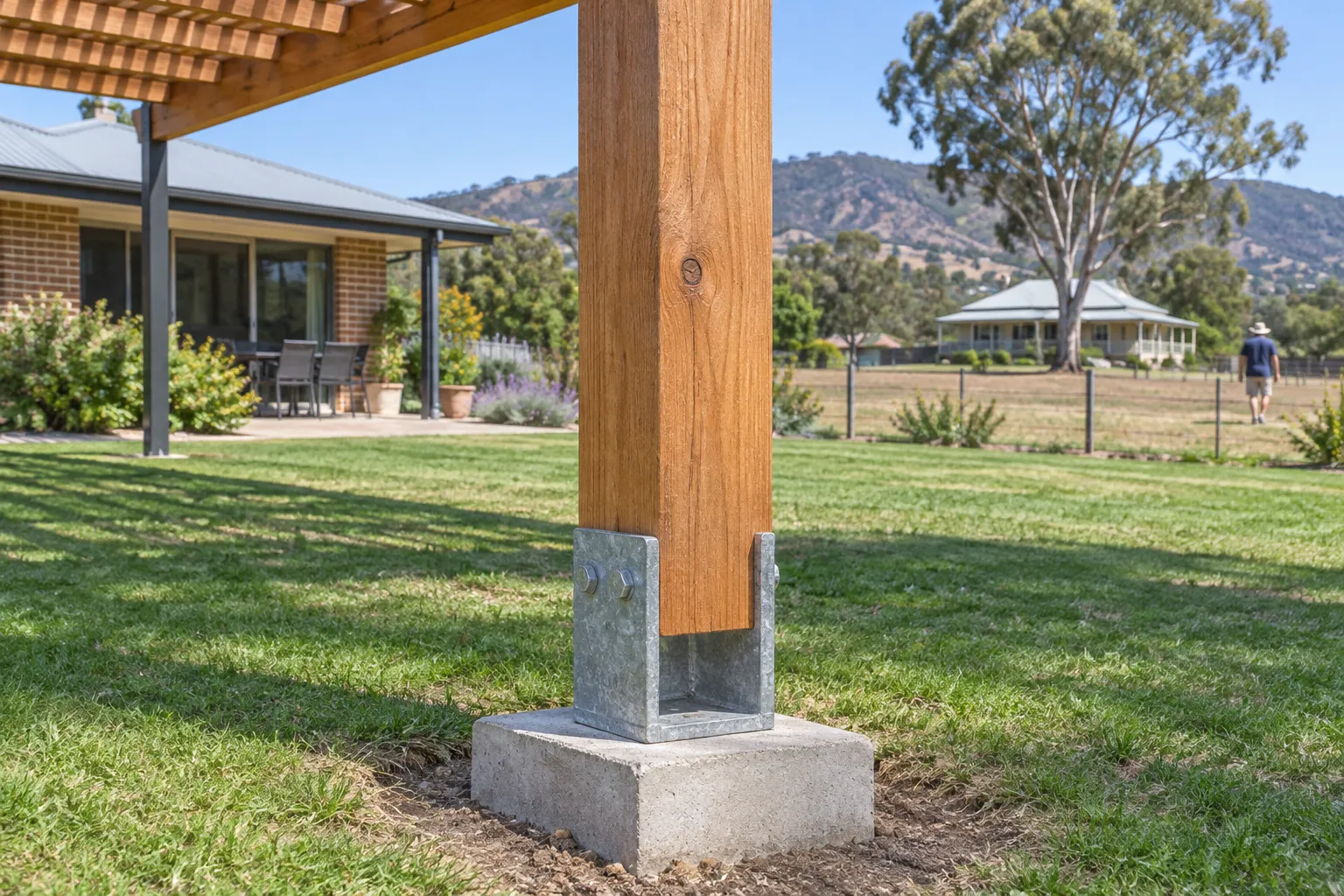
- Footings. Posts need concrete footings or post stirrups at the right depth for the soil. Albury's clay soils move between wet and dry seasons.
- Fixing to the house. An attached pergola hangs off the fascia or a wall plate. The house has to carry that load safely.
- Roof fall and water. A roofed pergola needs enough pitch to shed rain and a gutter that drains somewhere sensible.
If you're short on time or tools, a builder usually sets out, digs and stands a pergola in a few days.
Is it difficult to build a pergola?
An open timber pergola is one of the easier outdoor structures, but it's still building work. Most of the difficulty is in the first day: setting out square, getting the posts plumb and the footings level. After that it's cutting and fixing beams and rafters. Roofs, louvres and attaching to the house add the most difficulty.
A rough guide to how hard each type is:
| Pergola type | DIY difficulty | Usual reason to call a builder |
|---|---|---|
| Open timber, freestanding | Moderate | Uneven ground, big spans |
| Open timber, attached to house | Harder | The fixing to the fascia or wall |
| Steel or Colorbond roofed | Hard | Roof fall, gutters, wind loads |
| Insulated panel roof | Hard | Heavy panels, flashing to the house |
| Louvred | Hard | Motors, alignment, drainage |
For roof choices, read Colorbond vs polycarbonate pergola roofing and our page on Colorbond pergolas.
How much does a pergola cost in Albury?
Published Australian price guides put a professionally built pergola at about $3,000 to $7,000 for an open timber frame, $5,000 to $12,000 with a polycarbonate roof, $6,000 to $15,000 with a Colorbond roof, and $10,000 to $25,000 for an insulated panel roof. Size, height, access and whether it attaches to the house move the price most.
What else adds to the cost:
- Approval. If the pergola is too big or high for exempt development, a development application or building permit adds fees and time.
- Bushfire rules. On bush fire prone land, which includes parts of Thurgoona, materials may need to meet a bushfire attack level.
- Lighting, fans and gutters. An electrician must do the wiring.
- Paint or stain on timber. Some quotes include it, many don't.
These are guide figures. The builder who visits gives you the real price in writing. Our pergola cost page goes into more detail by size and roof.
Do you need council approval for a pergola in Albury or Wodonga?
Often not, if it's small. In NSW, a pergola can be exempt development if it meets every state standard: generally no bigger than 25 square metres, no higher than 3 metres, floor no more than 1 metre above ground, behind the building line and set back from the boundaries. In Victoria, an unroofed pergola up to 20 square metres and 3.6 metres high usually needs no building permit.
The detail differs on each side of the river:
- Albury, Lavington, Thurgoona, Jindera (NSW). If the pergola fails even one exempt standard, it needs approval. Extra rules apply on bush fire prone land and in heritage areas.
- Wodonga, Beechworth, Yackandandah (Victoria). The VBA says a roofed verandah needs a building permit, and a pergola over the size or height limits does too. Heritage overlays can also need a planning permit.
Our page on pergola approval explains each step and where to check your own block.
Can I build a pergola against my fence?
Usually not right on the fence line if you want it to be exempt in NSW. The state rules for exempt pergolas generally need a gap from each boundary, often 900 millimetres, and the pergola can't rely on the fence for support. A boundary fence belongs to both neighbours. Fixing a structure to it can also damage it.
If you want shade right up to the fence, the options are a freestanding pergola set back slightly, a pergola with its own posts beside the fence, or applying for approval. Talk to your neighbour first if it will overhang or block light.
What size timber is best for a pergola?
Most timber pergolas use posts of 90 by 90 or 100 by 100 millimetres, beams of 140 to 240 millimetres deep, and rafters of 90 to 140 millimetres, depending on the span. Longer spans and roofed pergolas need bigger sections. The right size comes from the span tables in the Australian timber framing standard, not a rule of thumb.
Treated pine is cheapest and easy to work. Hardwoods like spotted gum or blackbutt cost more but stand up better to sun and weather. Steel posts and beams allow longer spans with fewer posts. For style ideas in each material, see timber pergola designs and pergola designs attached to the house. For a broader look, browse pergola designs.
Questions people ask
What are the disadvantages of aluminium pergolas?
Aluminium pergolas cost more than treated pine, can dent, and often look more commercial than timber. Thin kit sections can flex in strong wind if they're not anchored well. They don't rot or need painting, though, and they're light. For a hot Albury backyard, a pale finish stays cooler than dark aluminium.
What is better than a pergola?
It depends on what you want. A patio or verandah with a solid roof keeps rain off, which an open pergola doesn't. A shade sail is cheaper for summer shade. A louvred roof gives you both. Our guide to what is better than a pergola compares each option for cost and use.
Which is better, a wooden pergola or an aluminium pergola?
Timber looks warmer, is easy to adapt and costs less in treated pine, but needs oil or paint every few years. Aluminium needs almost no upkeep and won't rot or attract termites, but costs more and can look less natural. For a classic weatherboard house, timber often suits better. For a modern build in Leneva or Thurgoona, aluminium often fits.
Does a pergola add value to a house?
A well-built pergola can make a backyard more usable, and outdoor living space is something many buyers look for. How much value it adds isn't fixed: it depends on the house, the build quality and the market. A pergola that needed approval should have it, or it can cause problems when you sell.
How long does it take to build a pergola?
A simple open timber pergola usually takes a builder two to four days once footings are in. A roofed or insulated pergola can take a week or more, plus any time for approval. Weather and concrete curing time add days. The builder will give you a timeframe with the written quote.
In this section
- Colorbond pergolas
Colorbond pergolas for Albury and Wodonga backyards.
- Colorbond vs polycarbonate roofing
Colorbond vs polycarbonate pergola roofing compared for Albury: shade, light, heat, noise, hail, lifespan, cost and which suits your…
- DIY louvred pergola kits
DIY louvred pergola kits in Australia: how louvres work, manual vs motorised, what a kit includes, footings, drainage, approval and when…
- Pergola approval
Do you need approval for a pergola in Albury or Wodonga?
- Pergola builder
How to choose a pergola builder in Albury and Wodonga: licences and contracts, comparing quotes, questions to ask, approval, warning…
- Pergola cost
Pergola costs in Albury and Wodonga for 2026.
- Attached pergola designs
Attached pergola designs: fixing to the fascia, raised above the gutter, to a wall or a two-storey house, roof fall and drainage, approval…
- Pergola designs
Pergola design ideas for Albury homes: attached vs freestanding, flat, gable and louvred roofs, modern and traditional styles, materials,…
- Stratco pergola price list
What affects Stratco and other kit pergola prices: size, roof, options, installation, footings and approval, plus how to get an accurate…
- Timber pergola designs
Timber pergola design ideas: open rafters, flat roof timber pergolas, attached and freestanding, beam end details, timber choices,…
- Alternatives to a pergola
Alternatives to a pergola for Albury backyards: patios, verandahs, shade sails, louvred roofs, and trees, compared for shade, rain cover,…
See deck builder across Albury for the other services and what they cost.
Where these facts come from
- NSW Planning Portal, exempt development for balconies, decks, patios, pergolas and verandahs
- Victorian Building Authority, landscaping and outdoor structures
- NSW Government, general building work licences
- AlburyCity, bush fire prone land
- Published installed pergola prices from three Australian cost guides, checked November 2026
Updated