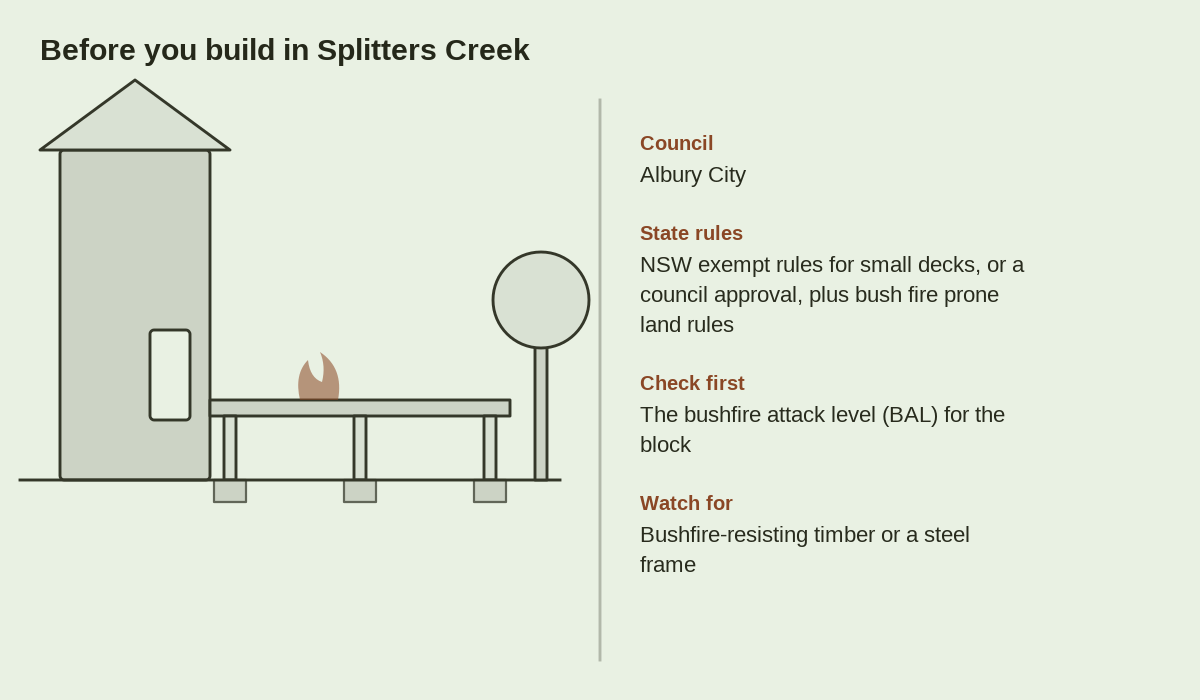
Splitters Creek is a semi-rural area on Albury's western edge, surrounded by bush, and it has its own NSW Rural Fire Service Bush Fire Survival Map. That makes the bushfire attack level, or BAL, the single biggest factor in what a deck here can be built from. A timber deck close to the house is exactly the kind of structure the bushfire rules focus on. Most Splitters Creek blocks are also larger than suburban lots, with more room for a big deck or verandah. For the rest of the area, see our areas page.
What is a bushfire attack level?
A bushfire attack level is a rating of how much radiant heat, ember attack and flame a building could face in a bushfire, based on the vegetation nearby, the distance to it and the slope. Levels run from BAL-LOW through BAL-12.5, 19, 29 and 40 to BAL-FZ, the flame zone. The higher the BAL, the stricter the materials for decks and other structures attached to the house.
| BAL | What it means for a deck |
|---|---|
| BAL-LOW | Very low risk, few special requirements |
| BAL-12.5 and 19 | Many decking timbers usable, with conditions |
| BAL-29 | Bushfire-resisting timber or a board tested to BAL-29 |
| BAL-40 and FZ | Timber decking restricted, non-combustible materials usually needed |
Your block's actual BAL comes from a bushfire assessment.
Which decking timbers work on a Splitters Creek block?
For blocks up to BAL-29, the Queensland Government's timber database lists spotted gum, blackbutt, merbau (as kwila), red ironbark, silvertop ash, river red gum and turpentine as bushfire-resisting timbers. Of these, spotted gum and blackbutt are the most readily available around Albury. Treated pine decking isn't on that list.
See blackbutt decking timber and spotted gum decking.
Why consider a steel frame here?
Steel is non-combustible, and the Australian Steel Institute notes that steel construction gives more resilience at higher bushfire attack levels. On a bushland block, a galvanised steel frame removes the timber from under the deck, which is where embers can lodge and smoulder. Paired with a bushfire-resisting hardwood or a tested board, it's a common approach for Splitters Creek decks.
See steel deck framing vs wood.
Design details that matter in bushland
Beyond the boards, the details count. Leaves and bark that collect in gaps and under the deck feed embers, so the space under the deck is often enclosed with non-combustible screening or kept clear. Gaps between boards, the distance to the house walls and windows, and what's stored under the deck all matter. A builder familiar with bushfire construction will plan these.
A bushland deck checklist:
- Keep the space under the deck clear of leaves and stored timber.
- Screen or enclose underneath where the BAL requires.
- Use non-combustible stairs and supports at higher BALs.
- Keep vegetation back from the deck edge.
Approval on bush fire prone land
AlburyCity says new development on bush fire prone land is subject to the RFS document Planning for Bush Fire Protection. That can affect whether a deck is exempt and what it must be built from. Most Splitters Creek decks are best treated as needing a BAL assessment and a check of the approval path before design.
Asking for a quote in Splitters Creek
Tell the builder you're on a bushland block in Splitters Creek, share any existing BAL assessment, and describe the deck's position relative to the house and the bush. The builder will confirm the BAL, recommend materials that suit it, and give you a written quote that includes approval.
Questions people ask
How much does a deck cost in Splitters Creek?
Published Australian guides put an installed hardwood deck at about $280 to $600 a square metre, and a steel frame adds roughly $60 to $120 a square metre over treated pine. On higher-BAL blocks, non-combustible materials and screening add more. A written quote after a site visit gives the real figure for your block.
Are there council rules for decks in Splitters Creek?
Yes. Splitters Creek is within the City of Albury, so NSW rules apply, and bushfire mapping means Planning for Bush Fire Protection applies to new development on mapped land. That can affect materials and whether a deck is exempt. A bushfire assessment and a check with the council or a certifier come first.
This area guide is part of deck builder across Albury.
Where these facts come from
Updated