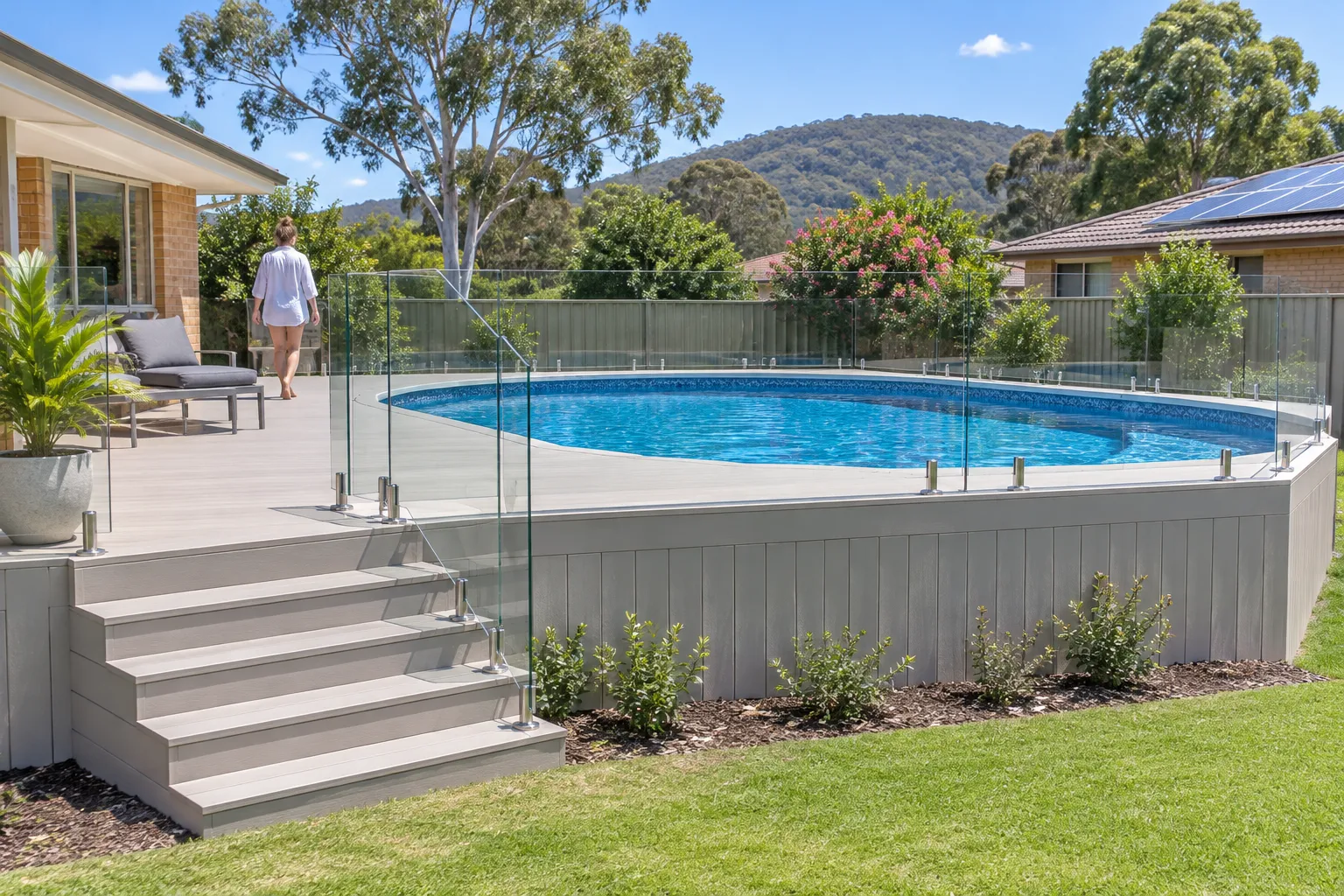
A deck around an above-ground pool is a raised deck built on its own frame and footings, set to the pool's rim height or a little below, so it never leans on the pool wall. It usually covers one end or part of the pool, with steps up and a balustrade. Because the deck becomes the way into the pool, its edges, gate and balustrade usually form part of the pool barrier and must meet the pool barrier rules. For materials and the general rules, see our main pool decks page.
Why must the deck have its own frame?
Above-ground pool walls are designed to hold water, not to carry the weight of a deck and people. A deck that rests on or fixes to the pool wall can damage it or void its warranty. So the deck stands on its own posts and footings, close to the pool but not touching it, with a small gap at the rim. The pool maker's instructions often say this too.
What this means in practice:
- Separate footings around the pool, not under it.
- A small gap between the deck edge and the pool wall.
- No fixings into the pool frame unless the maker allows it.
How high should an above-ground pool deck be?
Most above-ground pool decks sit level with the pool rim or a little below, so you can step in easily or sit with your feet in the water. If the deck is more than 1 metre above the ground below, the National Construction Code requires a balustrade at least 1 metre high with gaps no wider than 125 millimetres. Many pool decks reach that height.
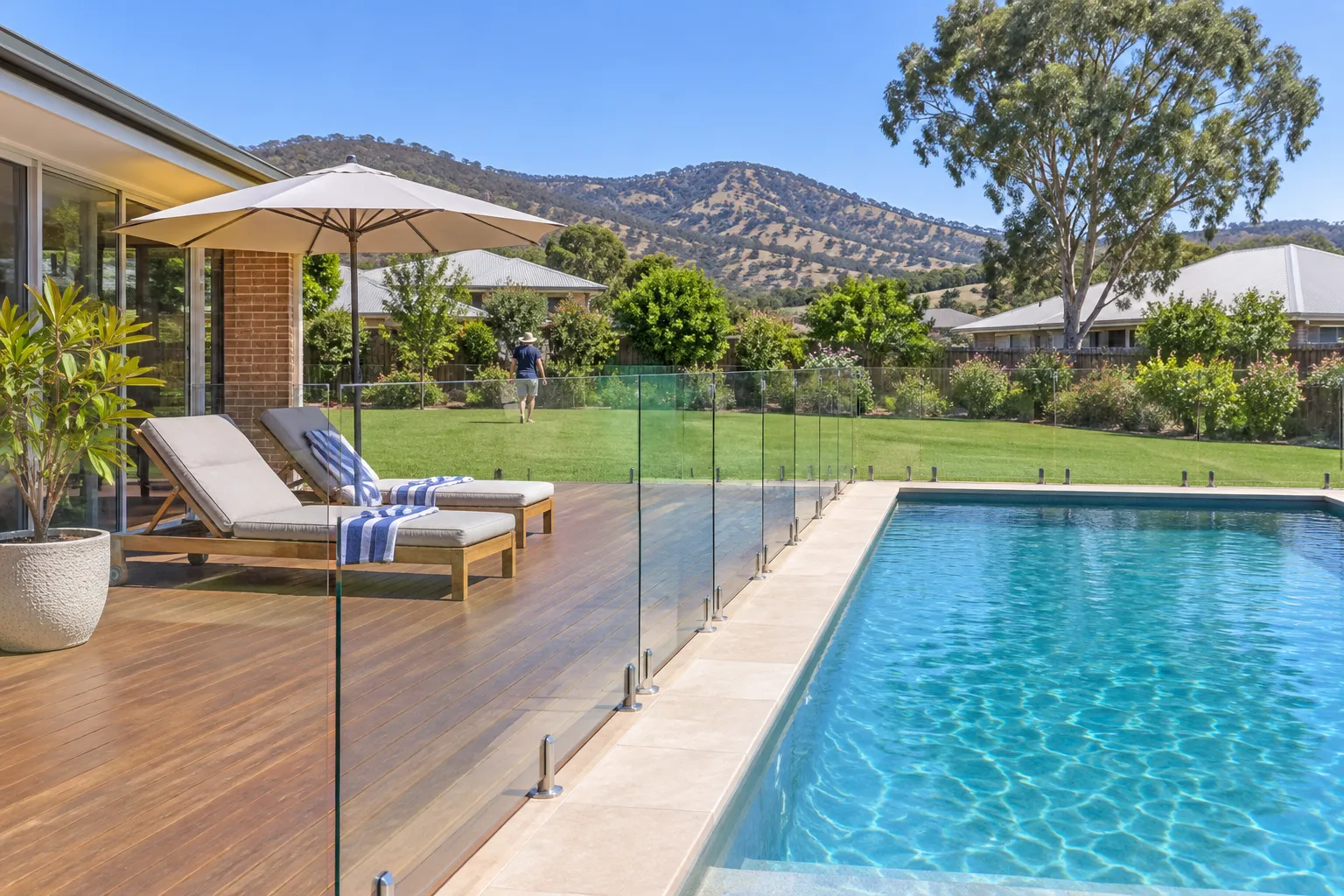
The height also affects approval. In NSW, a deck is only exempt development if its floor is no more than 1 metre above ground and it meets the other standards. In Victoria, most decks need a building permit.
How does the pool barrier work with a deck?
When a deck gives access to an above-ground pool, the deck's balustrade, gate and edges usually become part of the pool barrier. They must meet the pool barrier standard: the right height, no climbable footholds, and a gate that self-closes and self-latches. Objects near the barrier, like benches and pot plants, must stay out of the non-climbable zone.
The NSW Government says objects mustn't be within 90 centimetres of the pool fence. In Victoria, the VBA publishes the barrier requirements, and pools must be registered with the council. Plan the barrier as part of the deck design.
How do you build a deck around an above-ground pool?
Plan the layout around the pool and filter, set footings around the pool, build a level frame to the chosen height, lay the boards, then add stairs, the balustrade and a compliant gate. Leave a hatch or removable panel to reach the pump and filter. Check the barrier once it's finished.
The steps:
- Measure the pool's rim height, its position, and where the filter and pump sit.
- Check approval and the pool barrier rules.
- Set out footings around the pool, clear of its base.
- Build the frame to height, braced, level and separate from the pool.
- Lay the boards, with a gap at the pool rim.
- Add stairs, balustrade and gate that meet the barrier standard.
For general deck steps, see how to build a deck.
Which materials suit an above-ground pool deck?
Light-coloured composite and pale hardwood are popular, because they stay cooler underfoot and don't splinter when looked after. Treated pine is cheapest but needs oiling often near water. Merbau's tannin can stain the pool liner or surrounds when new. The frame is usually H3 or H4 treated pine, or steel.
See composite pool decking and pool timber decking for detail.
How much does an above-ground pool deck cost?
Using published Australian decking prices, plus about $50 to $120 a square metre for decks over 600 millimetres, a 12 square metre deck at one end of an above-ground pool often costs around $2,800 to $9,800 depending on the board, before stairs, balustrades and fence changes. See pool decks cost for more sizes.
What about a sliding deck pool cover?
A sliding deck cover is a section of decking on rails or rollers that slides over the pool when it's not in use. It's a specialised build that needs careful engineering, and it isn't a substitute for a compliant pool barrier unless it meets the pool barrier standard and has been approved as one. Most above-ground pool owners use a standard pool cover with a roller instead.
For more layouts, see deck pool ideas.
Questions people ask
Can you attach a deck to an above-ground pool?
Usually not. Most above-ground pool walls aren't designed to carry a deck, and fixing to them can damage the pool or void its warranty. The deck should stand on its own posts and footings with a small gap at the pool rim. Check the pool maker's instructions before planning any connection.
Does an above-ground pool deck need council approval?
Often it does, especially if it's more than 1 metre high or forms part of the pool barrier. In NSW, a deck is exempt only if it meets every standard. In Victoria, most decks need a building permit. The pool barrier must comply either way. A builder or certifier can confirm what applies to your deck.
How long does it take to build an above-ground pool deck?
A small platform with steps at one end of an above-ground pool often takes a builder three to five days. A deck wrapping half the pool, with a balustrade and gate, can take a week or more. Approval and barrier certification come on top. The builder gives you a timeframe with the written quote.
Do you need a balustrade on an above-ground pool deck?
If the deck is more than 1 metre above the ground below, the building code requires a balustrade. Even on lower decks, a balustrade is usually needed as part of the pool barrier where the deck gives access to the pool. It must meet the pool barrier standard, including height and no climbable footholds.
This guide is one of many on deck builder in Albury.
Where these facts come from
- Australian Building Codes Board, National Construction Code
- NSW Government, owning a pool or spa: your obligations
- Victorian Building Authority, swimming pool barriers and other requirements
- Published installed decking prices from four Australian cost guides, checked November 2026
Updated