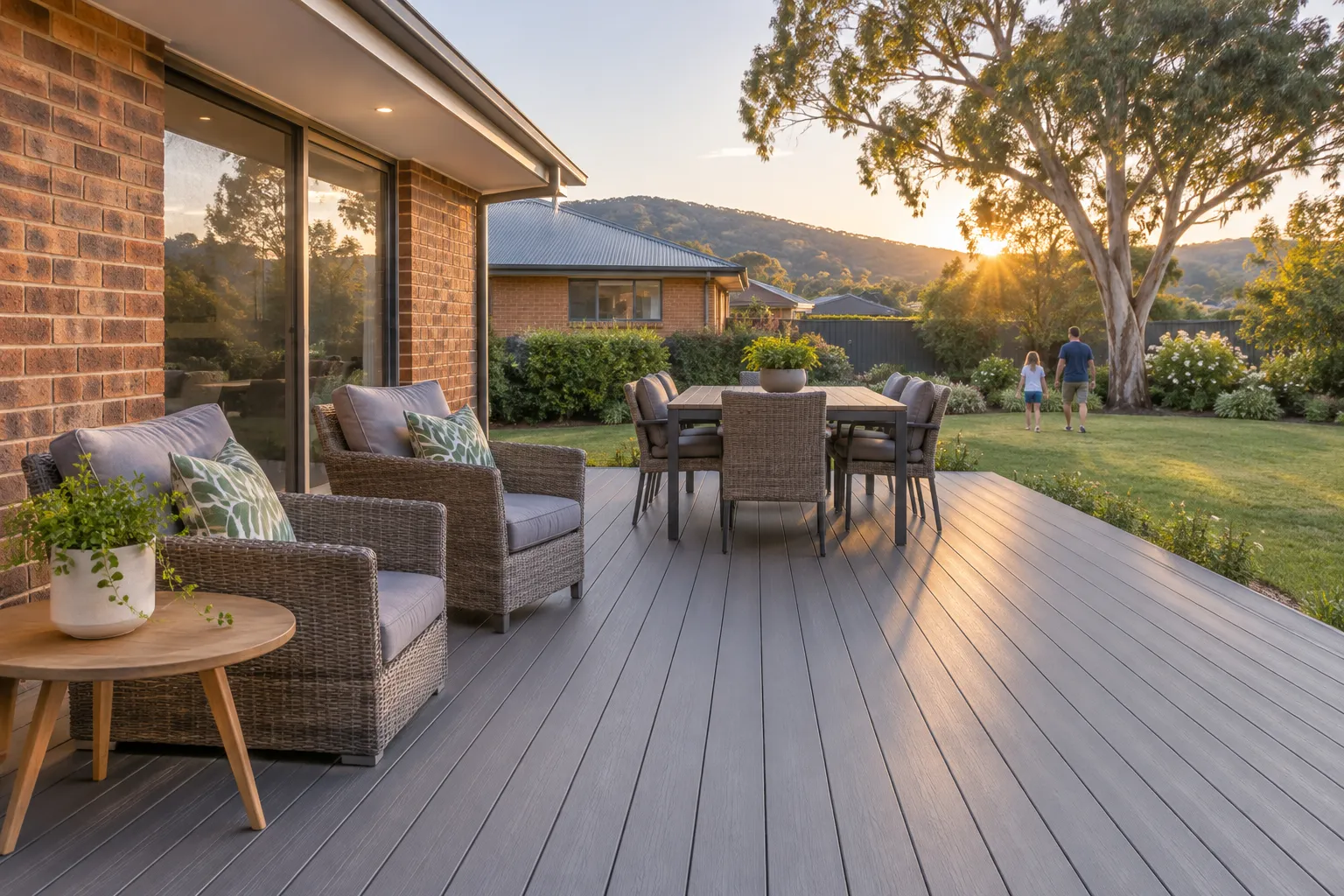
Hardwood decking and composite decking cost about the same to build around Albury: published Australian guides put installed hardwood at about $300 to $600 a square metre and standard composite at about $280 to $700. Composite wins on upkeep, because it needs no oiling and won't rot or splinter. Hardwood wins on feel, cooler pale colours, repairability and, for listed species like spotted gum, bushfire performance. Your budget for upkeep, your block's bushfire rating and the look you want usually decide it. For composite in detail, see our main composite decking page.
How do hardwood and composite compare side by side?
Side by side, the biggest differences are upkeep and repairs. Hardwood needs oiling every 12 to 24 months to keep its colour, but scratches and wear can be sanded out. Composite needs only washing, but deep damage means replacing a board. Both last a long time above ground when built well. Heat and bushfire rules are the other big factors in Albury.
| Hardwood (spotted gum, merbau) | Composite | |
|---|---|---|
| Installed cost | About $300 to $600 per m2 | About $280 to $700 per m2 |
| Upkeep | Clean and oil every 12 to 24 months | Wash a few times a year |
| Heat in sun | Pale species stay cooler | Dark colours get hot |
| Repairs | Sand and re-oil | Replace the board |
| Termites and rot | Resistant above ground in good species | Boards resistant |
| Bushfire | Some species listed as bushfire resisting | Only boards tested to a BAL |
| Feel | Natural, varies board to board | Consistent, slightly synthetic |
Which costs less over 15 years?
Over 15 years, composite often costs less, because hardwood needs regular oiling. Published NSW guides put a professional clean and re-oil at about $15 to $35 a square metre. On a 30 square metre hardwood deck oiled every 18 months or so, that's roughly $4,500 to $10,000 of upkeep over 15 years. If you oil it yourself, hardwood stays very competitive.
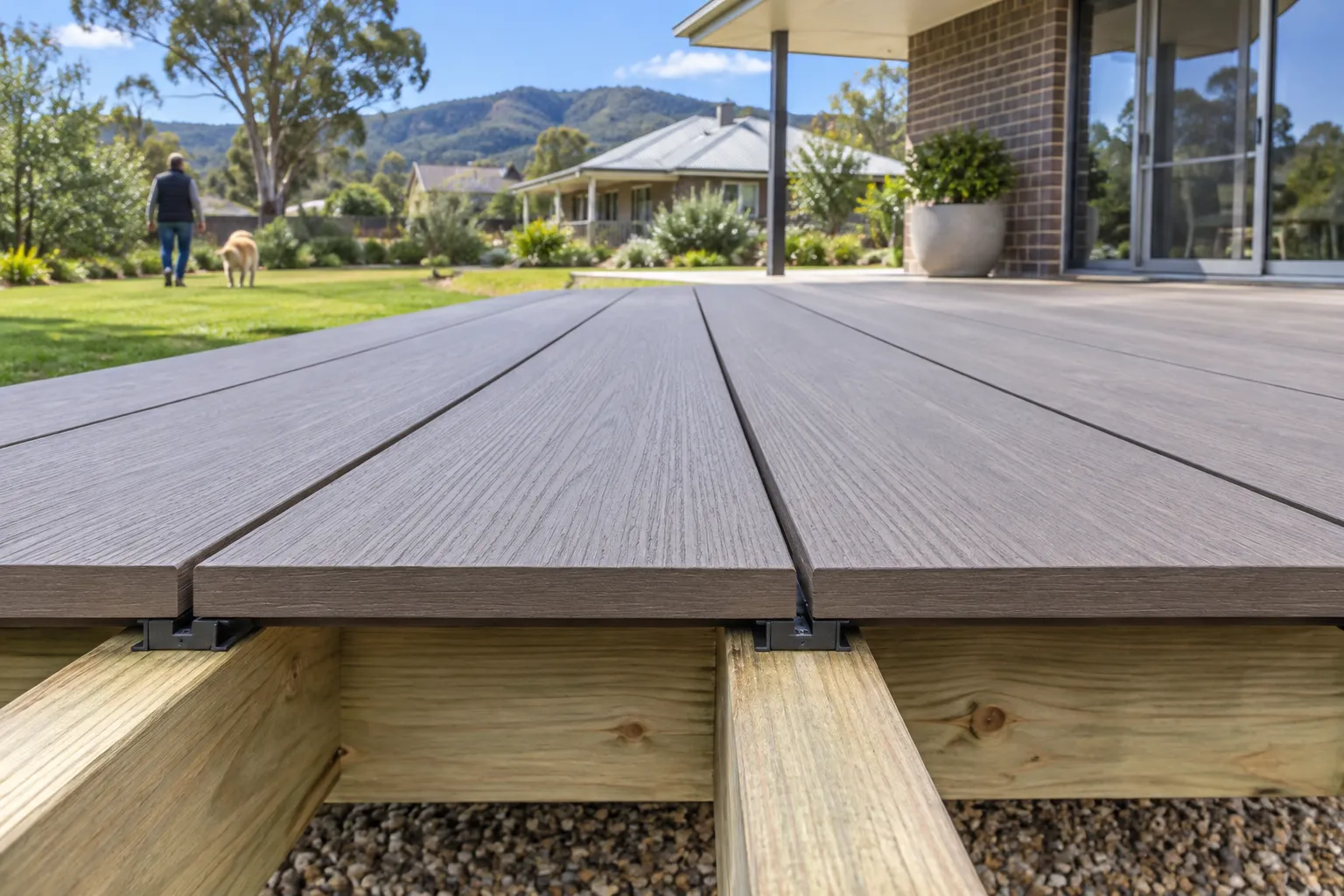
For the full numbers, see composite decking cost and spotted gum decking cost.
Which is better in Albury's heat and frost?
Both handle frost and wet winters well when built with good airflow. In summer, pale hardwoods like spotted gum and blackbutt usually stay cooler underfoot than dark composite. Light-coloured composite narrows the gap. Hardwood can check, meaning small surface cracks, if left unoiled in strong sun, while composite moves with temperature and needs end gaps.
What that means for choosing:
- Uncovered west-facing deck, used barefoot: pale hardwood or light composite.
- Covered deck under a patio roof: either, any colour.
- Shady, damp spot: composite resists rot, but both need washing to stop algae.
Which is better on bush fire prone land?
On bush fire prone land, which includes parts of Thurgoona, Splitters Creek and Jindera, the deck must suit the block's bushfire attack level. Spotted gum, blackbutt and merbau are listed as bushfire-resisting timbers, usable up to BAL-29. Composite boards must have been tested to the relevant level, and only some ranges have been. Above BAL-29, non-combustible materials are usually needed.
So on a BAL-29 block, a listed hardwood is a straightforward choice, and a composite only if the exact range carries that rating. See spotted gum decking for the bushfire detail.
Which lasts longer?
Both can last 20 years or more above ground when built well. Spotted gum heartwood is rated class 1 above ground by Business Queensland, with a life expectancy of more than 40 years. Capped composites carry long warranties. In practice, the frame underneath often fails first, so a good frame matters more than the board. A steel frame helps either.
See how long a wooden deck lasts and how long a composite deck lasts.
Which looks and feels better?
That's a matter of taste. Hardwood has natural colour variation and grain that changes board to board, and it feels like timber underfoot. Composite has a consistent look and colour, which some people prefer, and premium ranges look quite natural. Many owners decide by seeing both in person, in sun, on a finished deck.
How do you decide between them?
Choose composite if you want the least upkeep, the deck is covered or you'll pick a light colour, and your block isn't a high bushfire rating or the board is tested to it. Choose hardwood if you want a natural look, a cooler pale surface in sun, the option to sand out wear, or a listed bushfire-resisting timber.
Questions people ask
Is composite decking better than hardwood?
Not for everything. Composite is better for low upkeep and no rot or splinters. Hardwood is better for a natural look and feel, cooler pale colours and repairs by sanding, and some species suit bushfire areas. Installed costs overlap, so the right choice depends on your priorities and your block.
Is hardwood decking cheaper than composite?
Upfront, they're close: published guides put hardwood at about $300 to $600 a square metre installed and standard composite at about $280 to $700. Treated pine is cheaper than both. Over 15 years, composite often comes out ahead if you'd pay someone to oil hardwood, while doing it yourself keeps hardwood competitive.
Can you mix hardwood and composite on one deck?
Yes. Some decks use composite for the main area and hardwood for steps, a bench or a border, or the reverse. Each material needs its own fixing method and gaps, and the frame must suit the stricter one, usually the composite's closer joist spacing. The colours won't match exactly, so treat it as a deliberate contrast.
Which is better for a pool deck?
Composite is popular around pools because it doesn't splinter or need oiling despite splashing and sun. Pale hardwood stays cool and looks natural but needs oiling more often near water. Merbau's tannin can stain pool surrounds. See pool decks for the options and the pool barrier rules.
The rest of our guides start from Border Outdoor Living deck builder.
Where these facts come from
- Business Queensland, spotted gum timber properties
- Queensland Government timber database, bushfire-resisting timbers
- Published installed decking and deck oiling prices from four Australian cost guides, checked November 2026
Updated